Medisterpølse (Danish Sausage with Creamed Cabbage)
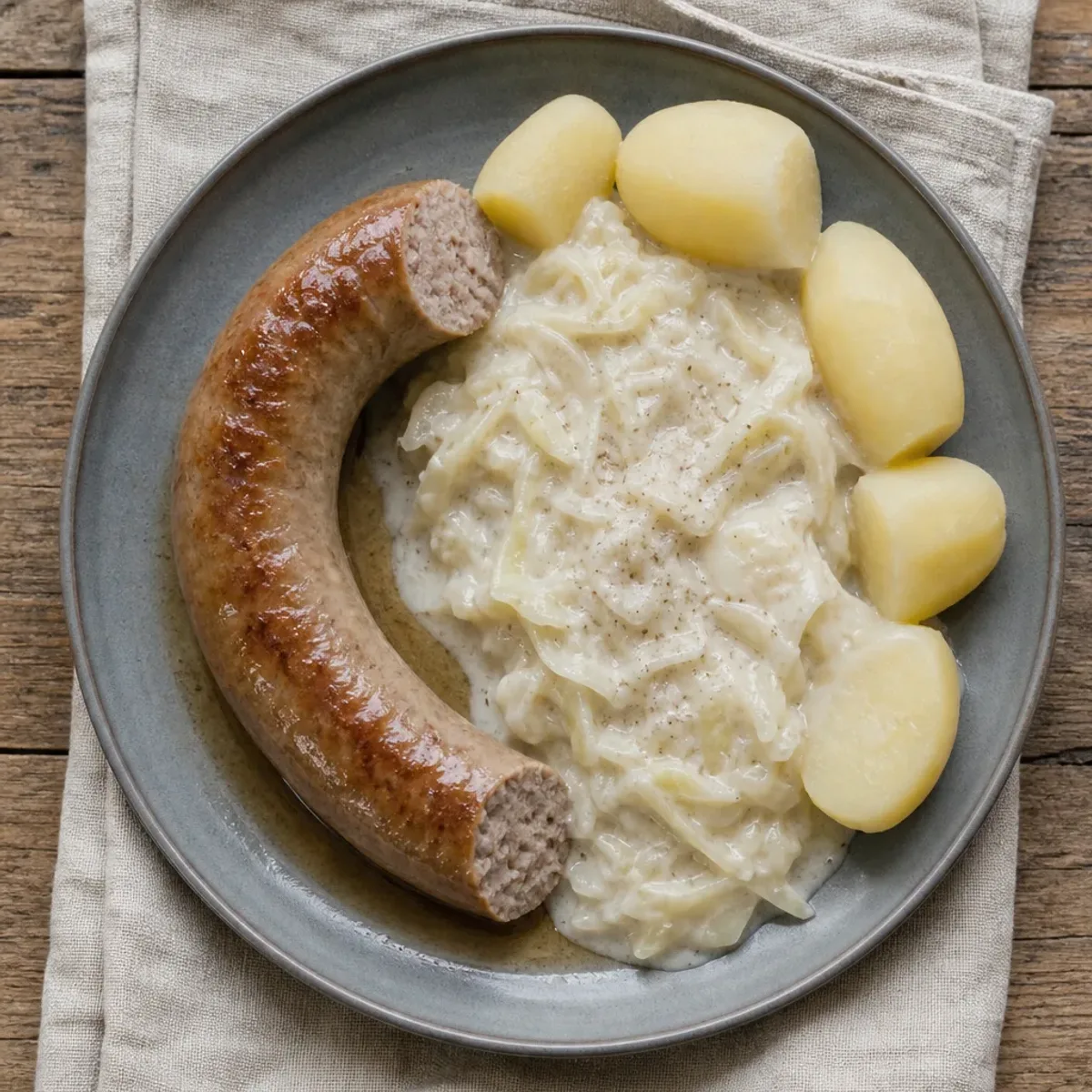
Coarsely ground Danish medisterpølse rolled into a spiral and fried golden, served with white cabbage slow-stewed in a nutmeg-scented béchamel.
While the medister is first browned and then finishes cooking slowly under a lid, the potatoes can be boiled and the white cabbage prepped for stewing. The cabbage is cooked until just tender with a little bite, then folded at the end into a smooth, creamy milk sauce, while the pan drippings are saved for serving. How thoroughly the medister is cooked through determines both juiciness and safety.
Ingredients
The Medisterpølse
- 800 g medisterpølse
- 25 g butter
Creamed White Cabbage
- 800 g white cabbage
- 40 g butter
- 40 g all-purpose flour
- 5 dl whole milk
- ½ tsp nutmeg, freshly grated
- salt, for the cooking water and to taste
- pepper, freshly ground
Boiled Potatoes
- 1 kg waxy potatoes
- 1 tbsp salt, for the cooking water
How to make it
Boiled Potatoes
- Peel the potatoes and cut the largest ones in half so all the pieces are roughly the same size and become tender at the same time. Put them in a bowl of cold water while you prepare the rest, so the cut surfaces don't turn gray. ⏱ 10 min
Creamed White Cabbage
- Peel off the outer leaves of the white cabbage and cut the head into quarters. Cut the tough core away from each quarter, and slice the cabbage into strips about 1 cm wide. The strips should still be visible in the finished dish, so don't slice them any finer. ⏱ 10 min
The Medisterpølse
- Roll the medisterpølse up into a flat spiral. Push two wooden skewers crosswise through the spiral so it holds its shape and can be turned in one piece.
- Melt the butter for the sausage in a large skillet over medium heat and add the medisterpølse. Brown it for 4 minutes on each side, until the skin is golden and taut. Don't pierce the sausage, or the meat juices will run out into the pan instead of staying in the meat.Chef's tip Medister skin is a thin natural casing that tightens as it heats; a fork prick or too fierce a heat bursts it and the fat leaks out. Keep the pan at a steady sizzle, not a spitting crackle, and turn with a spatula or tongs.
- Turn the heat down to low and cover the pan with a lid. Let the sausage finish cooking for 20-25 minutes, turning it once partway through. Medister is ground meat and must be cooked through: it's done when the juices that run out are completely clear and the core temperature is 75°C. The sausage is already salted by the butcher, so it doesn't need any further seasoning. ⏱ 20 min–25 min · passiveChef's tip The sausage should sizzle gently under the lid — if it's spitting and bubbling hard, fat and meat juices get forced out of the filling and the medister turns dry and crumbly instead of juicy.
Boiled Potatoes
- Put the potatoes in a pot, cover them with cold water and add the salt. Bring the water to a boil and cook the potatoes for 15-20 minutes, until a fork slides easily into the center without resistance. Drain the water and keep them warm under a lid. ⏱ 15 min–20 min · passive
Creamed White Cabbage
- Cook the cabbage strips in a pot of lightly salted water for 8-10 minutes, until tender but still with a little bite. Drain them into a strainer set over a bowl, and reserve 1 dl of the cooking water. ⏱ 8 min–10 min · passiveChef's tip Pull the cabbage while the strips still give a slight resistance at the bite — it sits in hot sauce for another few minutes afterwards and keeps softening. Boiled to full tenderness now, it collapses into the sauce.
- Melt the butter for the sauce in the empty cabbage pot over medium heat and whisk in the flour. Let the roux bubble for 2 minutes, stirring, until it smells lightly nutty — that's when the raw flour taste disappears.Chef's tip Two minutes of bubbling cooks off the raw pastiness of the flour; you'll smell something faintly like warm biscuits. Keep it pale — let it colour and the sauce turns beige and thickens less.
- Whisk in the whole milk a little at a time, waiting until the sauce is smooth again before adding the next splash. Let it simmer for 5 minutes, whisking regularly, until it's thick enough to coat the back of a spoon.Chef's tip The sauce only really thickens once it has simmered through and is bubbling — never judge the consistency while it's merely warm, or you'll thin it too far and end up with a dish that runs.
- Fold the drained cabbage into the sauce and thin with the reserved cooking water until the dish is creamy without running out on the plate. Let it heat through for 4 minutes, then season to taste with salt, freshly ground pepper and the freshly grated nutmeg. The nutmeg should be just perceptible behind the milk, not sit on top.Chef's tip Grated nutmeg loses its aroma fast in heat, so add it near the end rather than into the roux. Start with half the amount, taste, and add the rest — it turns soapy and medicinal when overdone.
- Lift the whole sausage spiral onto a platter and carry it to the table in one piece. Carve it at the table: pull out the wooden skewers and cut the spiral into curved lengths that follow the coil, so each plate gets one piece. Add a generous spoonful of creamed white cabbage alongside and arrange the boiled potatoes around it. Finally, pour the pan drippings from the skillet over the sausage.