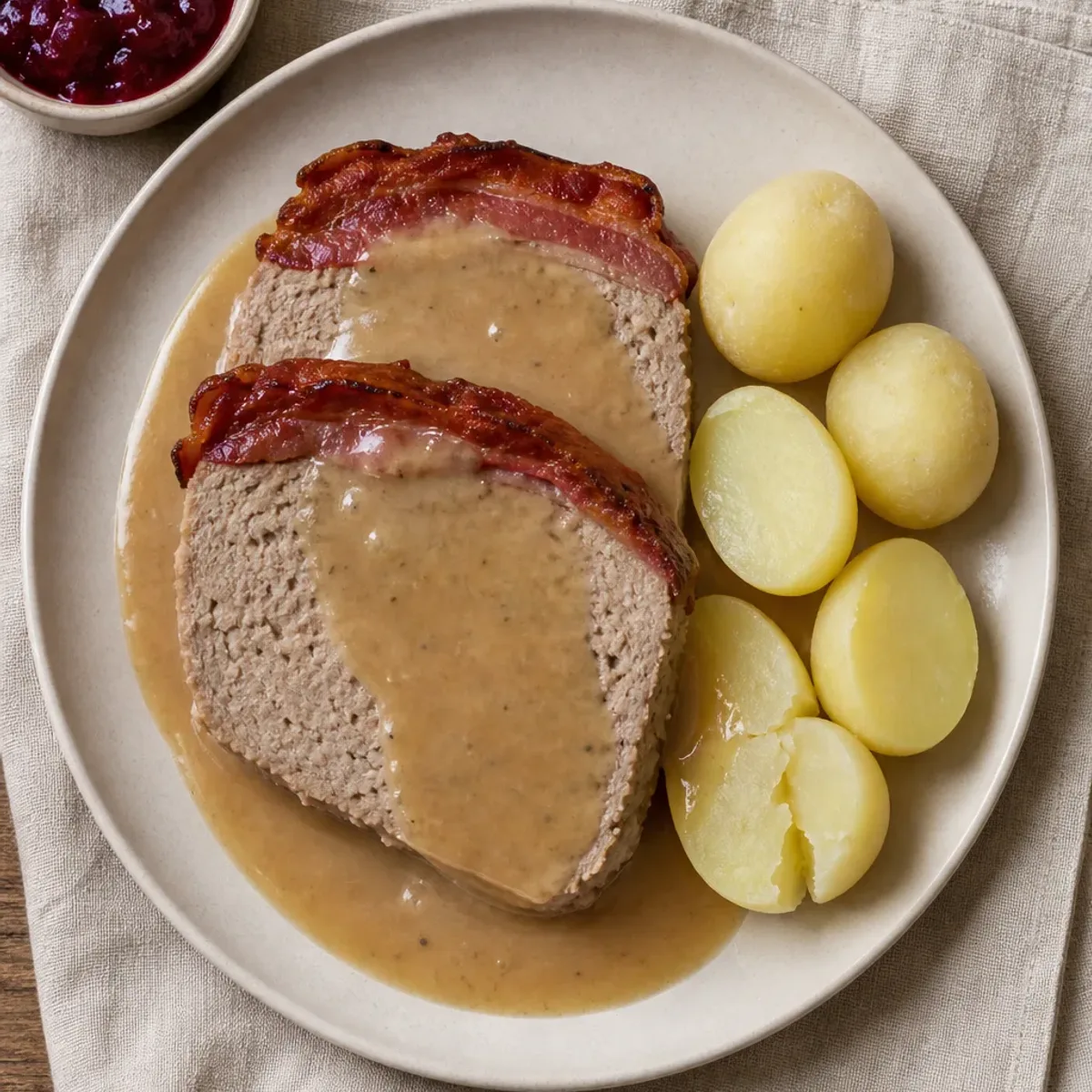
Forloren hare (Danish Meatloaf with Bacon)
A mixture of ground veal and pork shaped into an oblong roast and draped in bacon, playing the part of the fatback on a real hare.
The mixture is first beaten until elastic, then gradually loosened with milk, shaped, and covered in bacon while the oven heats up. The hare roasts in two stages, the potatoes are cooked alongside, and it rests while the pan juices become gravy. The elastic, properly bound mixture is essential so the hare can be cut into whole slices.
Ingredients
The meat mixture
- 700 g ground veal and pork
- 2 eggs
- 3 tbsp all-purpose flour
- 2 dl whole milk
- 2 tsp salt
- 1 tsp pepper, freshly ground
For roasting
- 150 g bacon, thinly sliced
- 3 dl water
- 2 dl heavy cream
The gravy
- 2 dl heavy cream
- 3 tbsp all-purpose flour
- 1 dl water, ice-cold
- salt, to taste
- pepper, to taste
To serve
- 1 kg potatoes, waxy
- 2 tsp salt, for the cooking water
- 1 dl redcurrant jelly
How to make it
- Preheat the oven to 200°C.
The meat mixture
- Put the ground veal and pork in a bowl with the salt and beat the mixture vigorously with a wooden spoon for 3 minutes. It's ready when it turns elastic and gathers around the spoon in a single mass. The salt draws out the meat's proteins, and it's these that hold the hare together during roasting.
- Stir the flour into the mixture along with the eggs. Then add the whole milk a little at a time while stirring constantly, and stir in the pepper last. The mixture should be glossy and smooth and just barely hold its shape on the spoon. If the milk is added all at once, the mixture can split.Chef's tip Add milk in splashes and let each disappear before the next; the protein net absorbs liquid only gradually. If it looks grainy or beads with liquid, keep beating — it usually comes back.
For roasting
- Shape the mixture into an oblong roast about 25 cm long in the middle of an ovenproof dish. Smooth the surface with a wet hand until it's completely even and free of cracks, where the fat would otherwise run out during roasting.
- Lay the bacon slices diagonally across the hare so they overlap slightly and cover the entire top from end to end. The bacon replaces the fatback a real hare lacks, and it forms the crust.
- Pour the water into the dish around the hare and roast it in the middle of the preheated oven for 45 minutes, until the bacon is browned and the fat has melted clear into the pan juices. ⏱ 45 min · passiveChef's tip The water in the dish keeps drippings from scorching into bitterness while they become gravy. Check midway that the pan hasn't run dry and top up if it has.
- Pour the heavy cream for roasting over and around the hare and continue roasting for 25 minutes. It's done when the meat thermometer reads 75°C in the center and the pan juices are golden brown. Ground meat must be cooked through all the way. ⏱ 25 min · passiveChef's tip Push the thermometer into the thickest part without touching the bottom of the dish. Let it climb much past 75°C and the juices get squeezed out of the meat fibers, leaving the roast dry and mealy — better to take it out and let the carryover heat finish the job.
- Peel the potatoes while the hare roasts. Cut the largest ones in half so all the pieces are the same size and become tender at the same time.
- Cook the potatoes over low heat in water with the salt for 20 minutes, until a knife slides out of the center without resistance. Drain the water and let them stand covered until serving. ⏱ 20 min · passiveChef's tip Keep the water at a lazy simmer, not a rolling boil — hard boiling batters waxy potatoes so the edges shed while the centers lag. Small bubbles breaking the surface is the pace you want.
For roasting
- Take the hare out of the oven and lift it onto a cutting board. Let it rest for 10 minutes under a loose sheet of foil, so the juices redistribute and the slices stay whole when you cut them. ⏱ 10 min · passive
The gravy
- Strain the pan juices from the dish into a saucepan and skim off the top layer of fat with a spoon. If there's less than 3 dl, top up with water. Add the heavy cream for the gravy and bring the gravy to a boil, until it bubbles gently around the edge.Chef's tip Skim while the fat sits in a distinct yellow layer on top — leave it in and the gravy turns greasy rather than glossy, and no amount of flour will fix that.
- Shake the flour for the gravy together with the ice-cold water in a jar with a lid, until the slurry is completely lump-free — flour only dissolves in cold water. Whisk the slurry into the boiling gravy a little at a time and let the gravy cook through for 4 minutes, until it flows thick and slow off the spoon.
- Stir a tablespoon of the redcurrant jelly into the gravy and season it to taste with salt and pepper. The jelly gives the sweet edge that belongs to the dish. The bacon has already salted the pan juices, so taste before adding more salt.Chef's tip Stir the jelly in off a hard boil and season afterwards — sweetness masks how the salt reads, so a gravy that tasted just right before the jelly will seem flat after.
To serve
- Cut the rested hare into slices about 1.5 cm thick with a sharp knife in long, steady strokes, so the bacon stays on each slice.
- Place two to three slices on each flat plate with the potatoes on the side and pour the hot gravy over the meat. Put the rest of the redcurrant jelly in a bowl and set it on the table, so everyone can spoon a dollop onto the edge of their plate and enjoy a bit of jelly with each bite of meat.