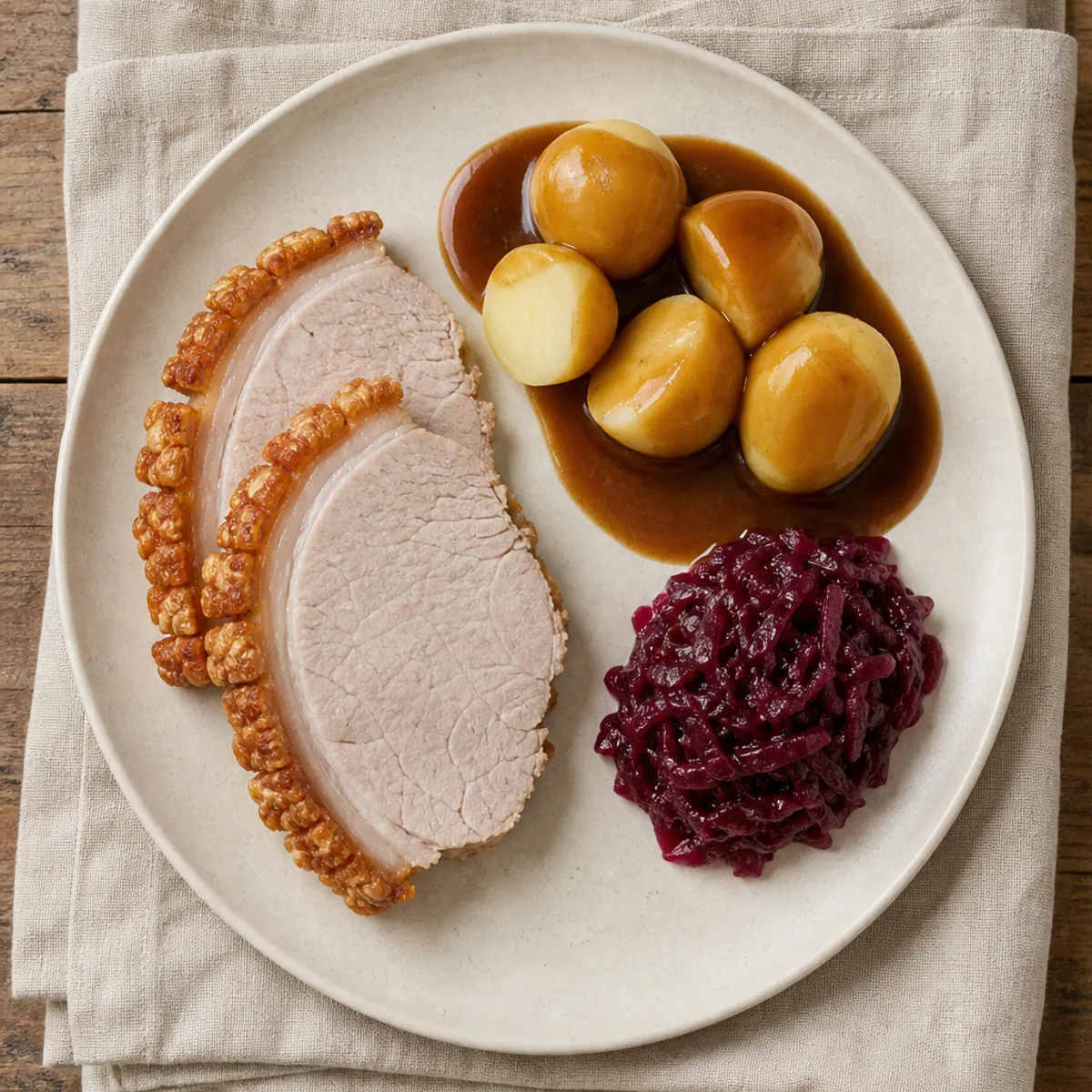
Flæskesteg (Roast Pork with Crackling, Gravy and Red Cabbage)
Christmas pork loin with scored crackling that gets one last blast of high heat for crispness, served with brown gravy and red cabbage.
The crackling is prepped and roasted hot first, while the red cabbage simmers tender in its sweet-and-sour braising liquid. Potatoes, resting time and the strained pan juices come together at the end in a brown gravy, so everything lands hot on the table. The one detail that makes or breaks it is fully crisp crackling.
Ingredients
The pork loin
- 1.8 kg pork loin with skin on
- 2 tbsp coarse salt
- 8 bay leaves
- 4 dl water, for the roasting pan
The red cabbage
- 1 pcs red cabbage, about 1.2 kg
- 40 g butter
- 1 dl vinegar
- 1 dl water
- 100 g sugar
- 1 tsp salt
- 1 dl redcurrant jelly
The potatoes
- 1 kg potatoes
- 1 tbsp salt, for the cooking water
The brown gravy
- 40 g butter
- 40 g all-purpose flour
- 3 dl veal stock, to stretch the pan juices
- 1 dl heavy cream
- 1-2 tsp gravy browning
- salt
- pepper, freshly ground
How to make it
The pork loin
- Score the skin crosswise with 4-5 mm between the cuts, all the way down to the fat but without cutting into the meat. Rub the coarse salt down into every groove, since the salt needs to sit at the bottom of the cut for the crackling to bubble up and turn crisp. Tuck the bay leaves down between the strips of skin. ⏱ 10 minChef's tip The cuts must reach the fat but stop at the meat — cut into the flesh and juices seep up into the grooves and steam the skin soft. Salt in the bottom of each groove draws out moisture so the strips can puff.
- Preheat the oven to 200°C.
The pork loin
- Place the roast skin-side up in a roasting pan, and level it so the skin sits perfectly horizontal. Otherwise the fat collects at the low end, and the high side turns tough. Pour the water into the bottom of the roasting pan around the roast, so it doesn't touch the skin.Chef's tip Crumpled foil or a few potato halves under the low corners will level a roast that won't sit flat. Water in the pan keeps the drippings from scorching, but a splash on the skin leaves a soft, leathery patch that never crisps.
- Place the roasting pan in the bottom third of the oven, and give the roast 30 minutes at 200°C, until the skin has tightened up and taken on a light golden tone. ⏱ 30 min · passive
- Turn the oven down to 175°C and continue roasting for 60-70 minutes, until a meat thermometer in the thickest part of the meat reads 65°C and the juices around the thermometer run clear. ⏱ 1 h–1 h 10 min · passiveChef's tip The meat still climbs a couple of degrees during the final blast and the rest, so 65°C in the thickest part is the finish line — take the reading clear of the fat layer. Much past about 70°C and the loin turns dry and grey.
The red cabbage
- Meanwhile, shred the red cabbage. Remove the outer leaves, cut the head into quarters and cut away the tough core. Slice the quarters into strips a couple of millimeters wide, so the whole cabbage becomes tender at the same time. ⏱ 15 min
- Melt the butter for the red cabbage in a large pot over medium heat. Toss in the cabbage with the vinegar, water, sugar and salt. Bring it to a boil while stirring, until the cabbage wilts down and turns from blue-violet to bright red.Chef's tip The blue-violet to bright red shift is the acid from the vinegar acting on the cabbage pigment — it's your sign the acid is properly distributed. Cabbage cooked without enough acid stays a dull grey-blue.
- Cover the pot and let the red cabbage simmer over low heat for 60 minutes, until the strips are completely tender and no longer have any bite. ⏱ 1 h · passive
- Stir the redcurrant jelly into the red cabbage and let it reduce, uncovered, for 10 minutes, until the liquid is syrupy and just barely covers the bottom of the pot. Season to taste with more vinegar or sugar, so the acidity and sweetness are evenly balanced. ⏱ 10 min
The potatoes
- Peel the potatoes and cut the largest ones in half, so all the pieces are roughly the same size and become tender at the same time. ⏱ 10 min
- Put the potatoes in a pot with cold water, just enough to cover them, and add the salt. Boil them for 18-20 minutes, until a knife slides in to the center without resistance. ⏱ 20 min · passive
The pork loin
- Take the roast out and check the skin. If it isn't crisp all the way across, turn the oven up to 250°C and place the roast at the top for 6-10 minutes, until the skin bubbles up and crackles under the knife. Stay by the oven, since the crackling goes from crisp to burnt in no time. ⏱ 6 min–10 minChef's tip Top heat at 250°C is the last chance for crackling, and it turns bitter within a minute or two of going too far. Listen for the crackle and watch for even bubbling — if one corner races ahead, shield it with a strip of foil.
- Lift the roast onto a cutting board and let it rest for 15 minutes, so the meat juices redistribute instead of running out onto the board. Leave it uncovered, so the crisp crackling doesn't steam soft. ⏱ 15 min · passive
The brown gravy
- Strain the pan juices from the roasting pan through a fine-mesh sieve into a measuring cup, and skim the clear fat off the top with a spoon. Top up with the veal stock, until you have 6 dl of liquid in total — if you're short on liquid, top up with water.
- Melt the butter for the gravy in a saucepan over medium heat. Whisk in the flour, and let the roux bubble for 2 minutes while whisking constantly, until it smells lightly toasted without taking on color.
- Add the strained pan juices a little at a time while whisking vigorously, so the gravy is completely smooth before the next splash. Add the heavy cream and let the gravy simmer over low heat for 8-10 minutes, until the raw flour taste is gone and the gravy flows slowly off the spoon. ⏱ 8 min–10 min
- Season the gravy to taste with salt and freshly ground pepper, and color it with gravy browning until it's a deep nutty brown. The pan juices are salty on their own, so taste before adding more salt.
The pork loin
- Slice the rested roast into slices about 1 cm thick. Set the knife into one of the grooves in the skin and cut straight through, so each slice gets its own piece of crisp crackling.
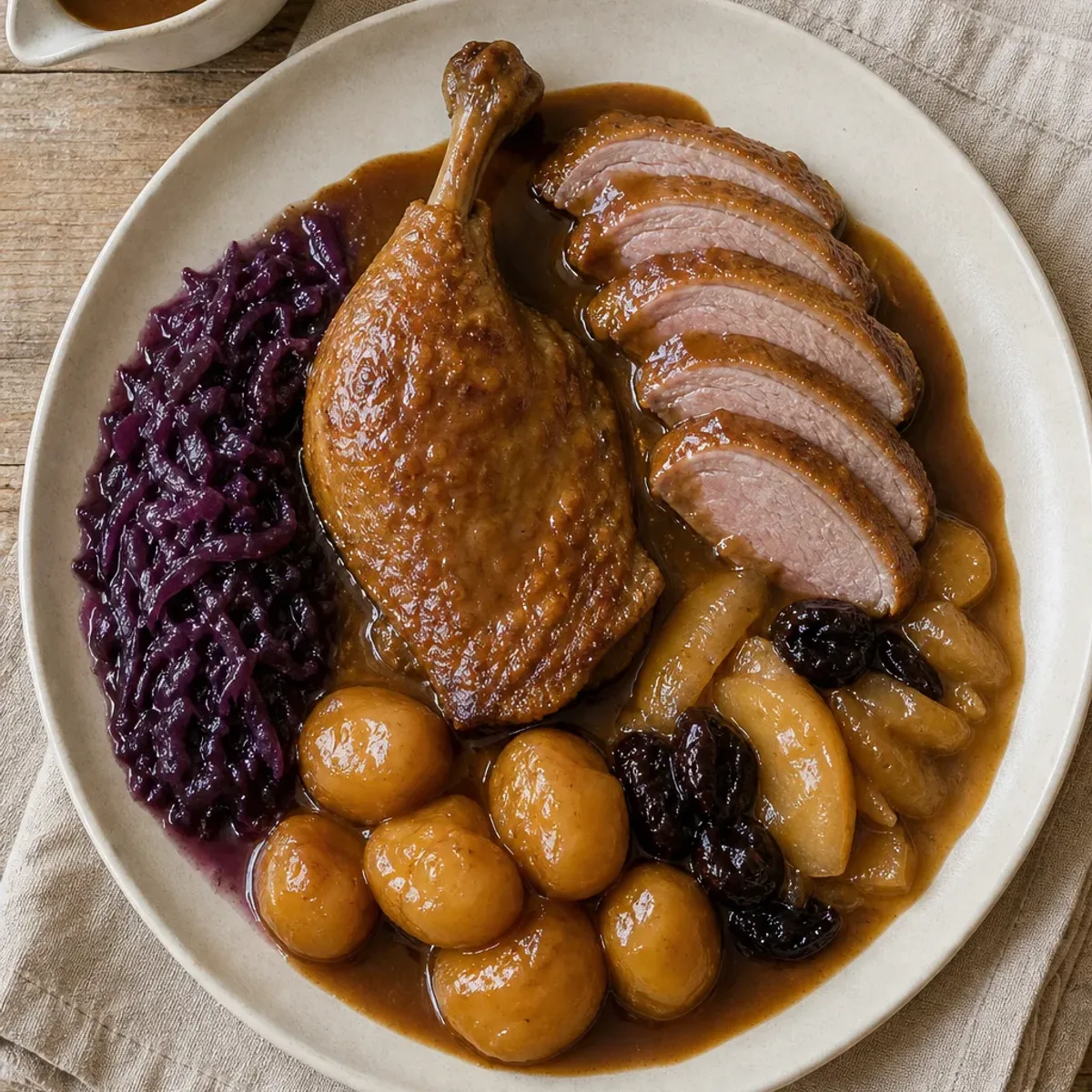
- Plate two slices of pork roast on each dinner plate with the potatoes alongside, and spoon the gravy over the potatoes. Put the remaining slices on a warm platter, the red cabbage in a bowl and the rest of the gravy in a gravy boat in the middle of the table, so everyone helps themselves. The red cabbage gets its own spot on the edge of the plate and shouldn't sit in the gravy.