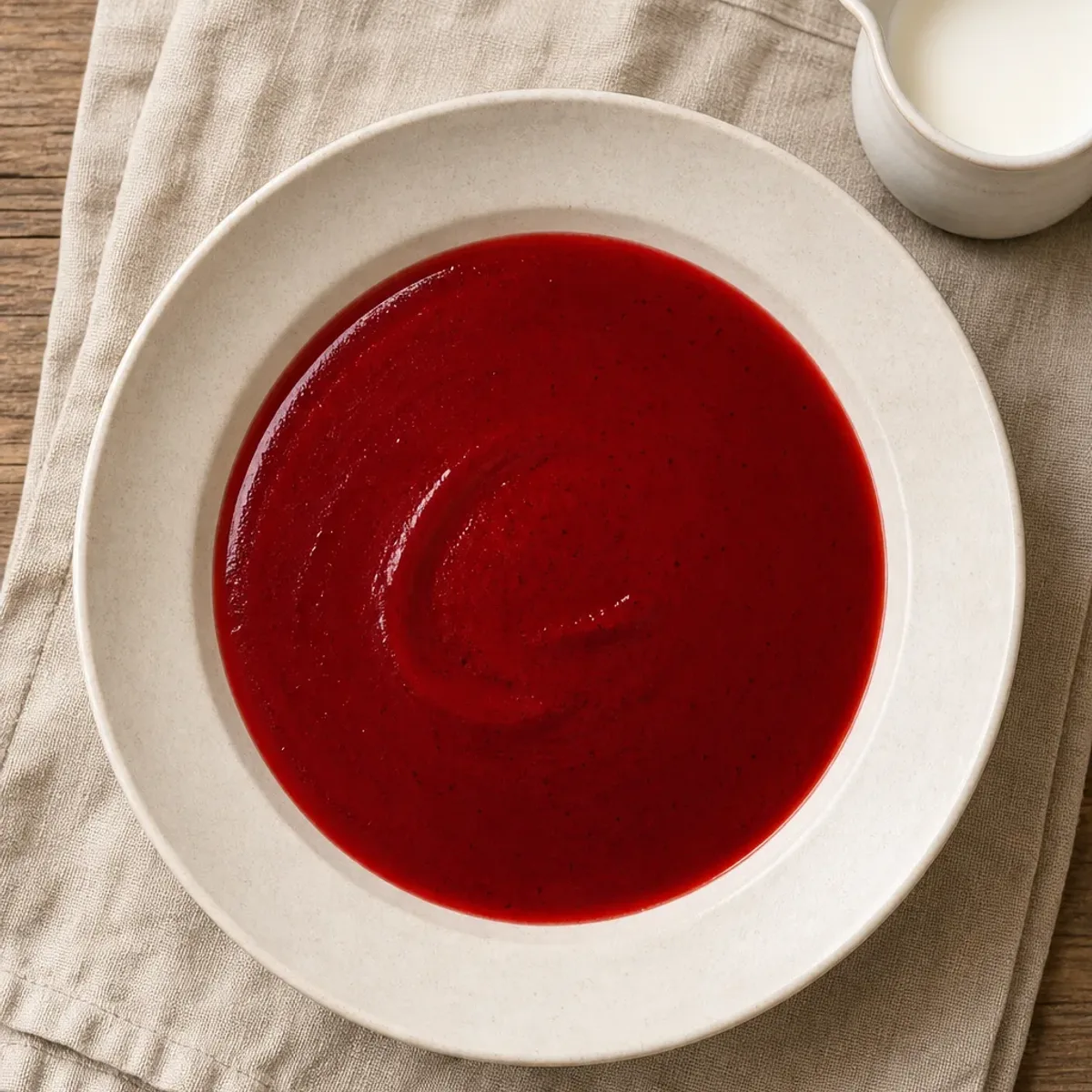
Rødgrød med fløde (Red Berry Pudding with Cream)
A Danish summer dessert of red currants and raspberries, thickened with potato starch and chilled until set, served with ice-cold heavy cream poured over at the table.
The berries are simmered tender with vanilla, and the juice is then left to run clear before it's sweetened and thickened. The hot pudding needs a sugar crust and must cool all the way through, while the cream is kept ice-cold for serving. The crucial finesse is the thickening: the potato starch must not be allowed to boil once it's added.
Ingredients
The pudding
- 500 g red currants
- 300 g raspberries
- 5 dl water
- 1 pcs vanilla bean, split lengthwise
- 175 g sugar
For thickening
- 3 tbsp potato starch
- 1 dl water, ice-cold
To serve
- 1 tbsp sugar, for sprinkling
- 3 dl heavy cream, ice-cold, not whipped
How to make it
The pudding
- Rinse the red currants and raspberries gently in cold water. Strip the currants from their stems by running a fork down along the cluster, and let all the berries drain in a sieve. ⏱ 10 min
- Put the red currants, raspberries, and the 5 dl water into a pot. Scrape the seeds out of the split vanilla bean, and add both the seeds and the pod to the berries. Bring it slowly to a boil and let it simmer for 8-10 minutes, until the berries have completely collapsed and the liquid is deep red. ⏱ 8 min–10 minChef's tip Keep it at a gentle simmer with only the odd lazy bubble. A rolling boil tears the pulp into shreds that slip through the sieve and leave the juice hazy and murky.
- Pour the berries and liquid into a fine-mesh sieve set over a bowl, and let the juice run through on its own for fifteen minutes. Press only very lightly on the berry mass at the end, because if you press hard, the pulp will pass through and the pudding will turn cloudy instead of clear and glossy. Fish out the vanilla pod and discard it. ⏱ 15 min · passive
- Measure the strained juice — there should be about 7 dl. Pour it back into the rinsed pot along with the sugar for the pudding, and bring it to a boil while stirring, until every grain of sugar has dissolved and the juice is completely clear.Chef's tip Measure honestly — much more than 7 dl and 3 tbsp starch leaves the pudding runny; much less and it turns stiff and gluey. Top up with water rather than guessing.
For thickening
- Stir the potato starch into the ice-cold water to a smooth, milky slurry with no lumps. Take the pot completely off the heat, and pour the slurry into the boiling juice in a thin stream while whisking constantly — potato starch loses its thickening power if it's allowed to boil again. Keep whisking until the pudding has thickened and flows slowly and glossily off the spoon.Chef's tip The slurry settles within a minute, so stir it again right before pouring — otherwise the starch stays at the bottom of the cup and the pudding stays loose. Ice-cold water keeps it from clumping.
The pudding
- Divide the hot pudding among four deep plates, and immediately sprinkle the tablespoon of sugar evenly over the whole surface while it's still steaming. The sugar melts into a thin, wet film that keeps the pudding glossy and prevents a skin from forming as it cools.Chef's tip Sugar only dissolves into a protective film on a steaming-hot surface; on cooled pudding it stays grainy and the skin has already begun. Sprinkle plate by plate, not after all four are filled.
- Let the plates cool at room temperature, then chill them for 2-3 hours. The pudding is ready when it's cold all the way through and has set enough that the trace left by a spoon holds for a moment before closing up again. ⏱ 2 h–3 h · passive
To serve
- Set the cold plates on the table along with the pitcher of ice-cold cream, and let everyone pour the cream over their own portion right before the first spoonful. The cream isn't stirred into the pudding but is left to spread out over the red surface, so each spoonful carries both cold pudding and cold cream.