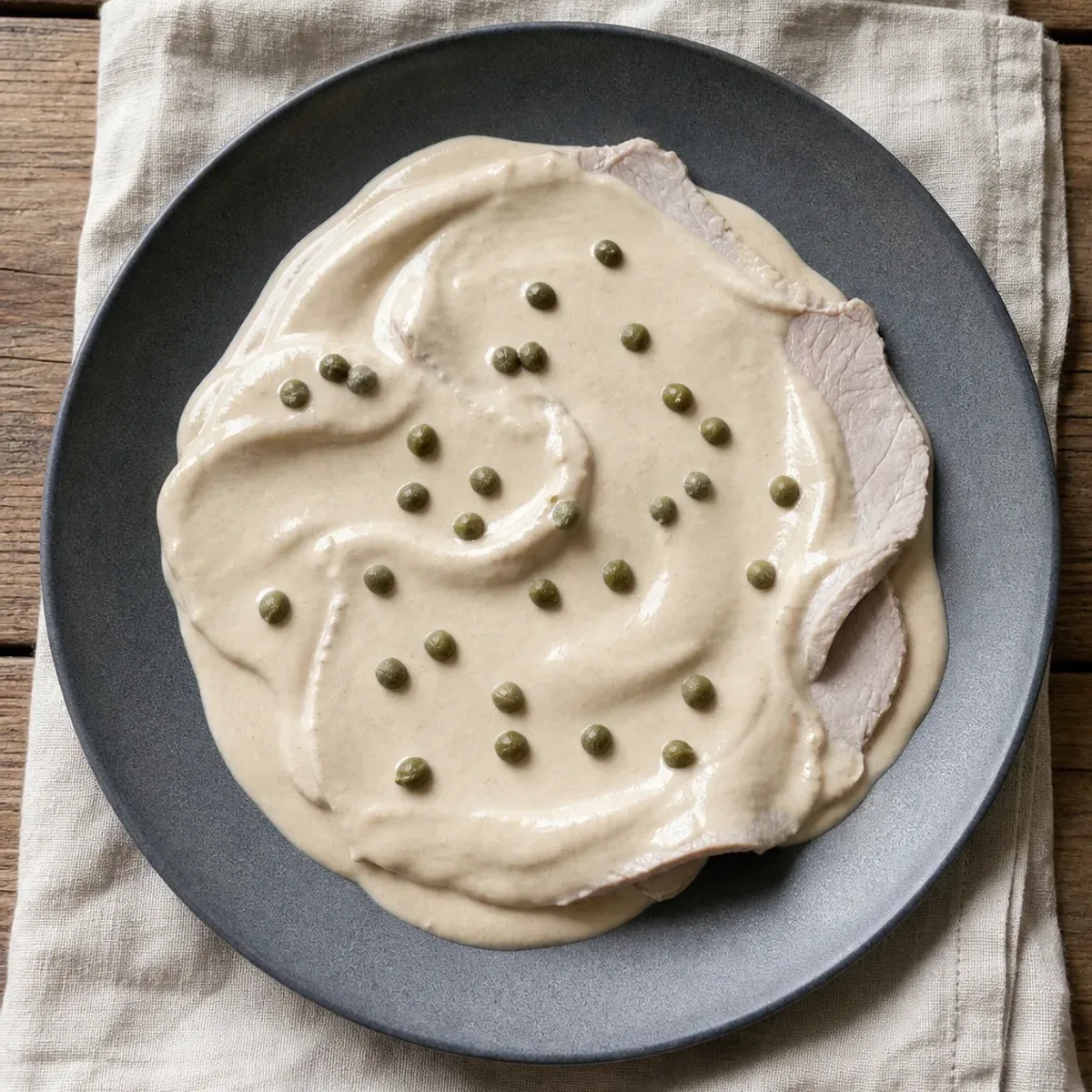
Vitello Tonnato
Piedmontese veal, poached and chilled, sliced paper-thin and covered with a sauce of tuna, capers, and egg yolks.
The veal marinates overnight, then poaches very gently in the liquid and finishes cooling in it while the tuna sauce is blended. The cold, thin slices are covered with sauce and given time to sit before serving. Gentle poaching is what determines whether the veal turns out juicy and tender.
Ingredients
The veal and poaching liquid
- 700 g veal top round, in one whole piece, trimmed
- 1 pcs carrot, cut into rough chunks
- 1 pcs celery, cut into rough chunks
- 1 pcs onion, halved
- 2 leaf bay leaf
- 10 pcs black peppercorns
- 5 dl dry white wine
- 1 l water, or more, to cover
- 2 tsp salt
The tonnato sauce
- 200 g tuna in oil, drained
- 4 pcs anchovy fillets in oil
- 3 pcs eggs
- 2 tbsp capers, drained
- 2 tbsp lemon juice, freshly squeezed
- 1½ dl olive oil, extra virgin
- pepper
To serve
- 1 tbsp capers, drained
How to make it
The veal and poaching liquid
- Place the veal top round in a pot together with the carrot, celery, onion, bay leaves, and peppercorns. Pour the white wine over, cover with a lid, and place the pot in the fridge (see Advance Prep). The wine serves as both marinade and poaching liquid, so the meat needs to lie fully covered by it. ⏱ 10 min
- Set the pot over medium heat and add water until the meat is just covered, then stir in the salt. Bring it slowly to a boil without a lid and skim off the gray foam with a spoon until the surface is clear. ⏱ 10 minChef's tip Skim during the slow climb to the boil — the foam is coagulating proteins, and once the liquid churns they break up and cloud it. A clear surface means the 1 dl you later use to thin the sauce stays clean-tasting.
- Turn down the heat until the liquid only trembles with the occasional bubble, and cover with the lid. Let the veal simmer for 50-60 minutes, until the meat thermometer reads 70°C at the center and the meat is cooked through with no pink center. Keep the liquid below a boil, since a rolling boil forces the juices out and makes the veal dry and stringy. ⏱ 50 min–1 h · passiveChef's tip Watch for a bubble breaking every few seconds, no more — around 80°C in the pot. A real simmer contracts the muscle fibres hard and squeezes out juice, which is what turns the slices dry and stringy.
- Remove the pot from the heat and let the meat cool completely in its own poaching liquid for about 2 hours, until it is cold all the way through. The meat draws in moisture as it cools, and only fully chilled veal can be sliced paper-thin. ⏱ 2 h · passiveChef's tip Don't shortcut the cooling by lifting the meat out early: veal left in air on the counter dries at the surface and firms unevenly. Cold to the centre is the test — press it, and it should feel solidly firm, not yielding.
The tonnato sauce
- Meanwhile, place a small pot of cold water with the eggs over heat and hard-boil them for a total of about 15 minutes from cold water, until the yolks are completely firm and pale yellow with no gray ring. ⏱ 15 min · passive
- Cool the eggs under cold water, peel them, and place the three yolks in a tall beaker. Add the drained tuna, the anchovy fillets, 2 tbsp capers, and the lemon juice, and blend with the immersion blender to a completely smooth, light brown paste with no visible tuna fibers. The whites are not used, as they make the sauce grainy and pale.Chef's tip The yolks are the sauce's emulsifier; their lecithin is what binds the oil. Blend the base completely smooth before the oil goes in — visible tuna fibers make the sauce grainy and keep it from coming together glossy.
- Keep blending while pouring the olive oil into the beaker in a thin stream, until the sauce comes together and turns glossy and thick. Strain off 1 dl of the cold poaching liquid and thin the sauce with it, a spoonful at a time, until the sauce just barely flows slowly off the spoon. Season with pepper, as the anchovies and capers add plenty of salt, and the sauce will rarely need more salt.Chef's tip Keep the blender head pressed to the bottom of the beaker until the mixture down there is thick and glossy, and only then lift it slowly. If the oil goes in too fast, the sauce will break and turn thin and oily instead of creamy.
The veal and poaching liquid
- Lift the chilled veal out of the liquid and pat it dry. Slice it across the grain into paper-thin slices with a sharp knife, so thin that they bend softly over the blade. ⏱ 10 minChef's tip Cutting across the grain shortens the muscle fibres so the slices give way instead of pulling apart. Feel for the direction of the fibres on the surface first, then set the knife at a right angle to it.
To serve
- Spread a thin layer of sauce over the bottom of a large flat platter, and arrange the slices in a single layer so the edges just touch. Cover them completely with the remaining sauce, so no bare meat is left showing. ⏱ 10 min
- Cover the platter and refrigerate for at least 1 hour, so the sauce soaks into the slices and the edges stay soft. ⏱ 1 h · passive
- Take the platter out of the fridge 15 minutes before serving, so the meat isn't ice-cold and the sauce regains its fullness. Sprinkle the capers for serving on top, and let each guest take three to four slices with sauce directly from the platter. ⏱ 15 min · passive