Tortellini in Brodo
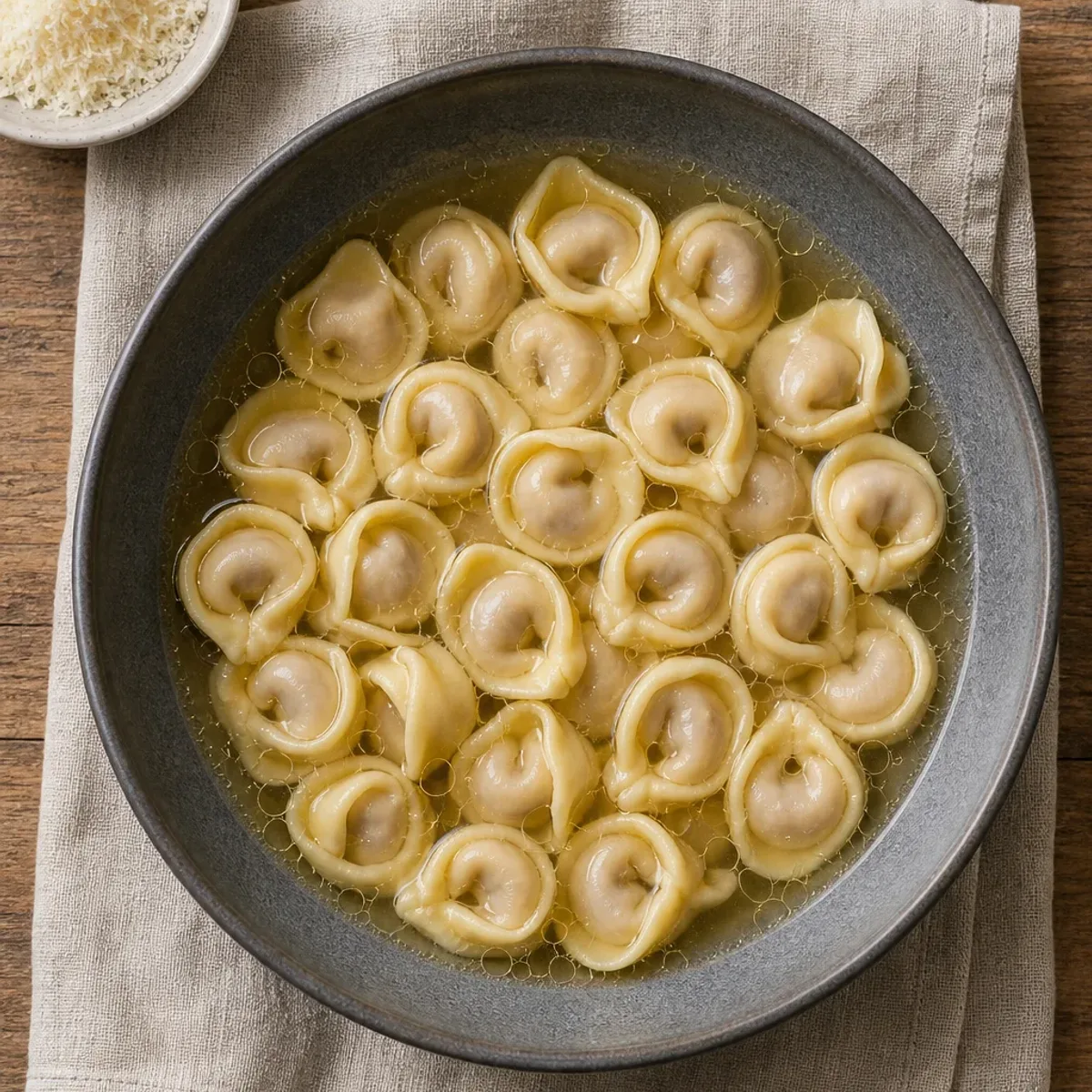
An Emilian Christmas tradition: little pasta parcels filled with pork loin, prosciutto and mortadella, served swimming in a clear beef and chicken broth.
The filling needs time to firm up in the fridge first, while the broth builds slowly and clear. As it simmers, the sfoglia is kneaded, rested and rolled out, before the tortellini are shaped and cooked directly in the strained broth. Tight seals on the tortellini determine whether the filling stays where it belongs.
Ingredients
The Filling
- 150 g pork loin, in one piece
- 20 g butter
- 100 g prosciutto crudo, thickly sliced
- 100 g mortadella, thickly sliced
- 150 g parmigiano reggiano, freshly grated
- 1 eggs
- 1 pinch nutmeg, freshly grated
The Broth
- 600 g beef brisket, in one piece
- 800 g capon, in pieces, skin and bone on
- 3 l cold water
- 1 carrot, roughly chopped
- 1 celery, roughly chopped
- 1 onion, halved
- 1 tbsp coarse salt
Sfoglia
- 400 g tipo 00 flour
- 4 eggs
To Serve
- 40 g parmigiano reggiano, freshly grated
How to make it
The Filling
- Brown the pork loin in the butter in a small pan over medium heat for 10-12 minutes. Turn it often, until it's golden all the way around and cooked through with no pink in the middle. The meat needs to be fully cooked at this stage, since the filling gets no other heat than the few minutes in the broth. ⏱ 10 min
- Take the meat off the pan and let it cool completely for 20 minutes, until it's cold to the touch. Warm meat melts the fat in the mortadella and makes the filling mushy. ⏱ 20 min · passive
- Grind the cooled pork loin, prosciutto crudo and mortadella very finely in a meat grinder or food processor. The mixture should be even and fine-grained, with no visible pieces of meat or fat. ⏱ 10 min
- Stir the freshly grated parmigiano reggiano into the filling, along with the egg and the grated nutmeg, until the mixture holds together in a firm ball when you press it in your hand. Taste it — it should taste distinctly salty on its own, since the prosciutto, mortadella and cheese are the filling's only source of salt. Cover the bowl and chill the filling (see advance prep), so the flavors meld and the mixture firms up enough to portion.
The Broth
- Put the beef brisket and capon in a large pot and pour the cold water over, so the meat is just covered. Bring it slowly to a boil, skimming the gray foam off the surface with a spoon for the first 20 minutes. The liquid should be clear and glossy when you're done — the skimming determines whether the broth turns out clear or cloudy. ⏱ 20 minChef's tip Don't stir the pot while it comes up to heat. Every stir tears the coagulating proteins apart, so they turn into cloudy particles in the liquid instead of a cohesive foam you can lift off.
- Add the carrot, celery, onion and coarse salt, and set the lid ajar. Let the broth simmer completely gently for 3 hours, until it smells deeply and tastes richly of meat. It should only tremble with the occasional bubble, since a hard boil shakes fat and particles loose into the liquid and clouds it. ⏱ 3 h · passive
Sfoglia
- Knead the tipo 00 flour and the four eggs together on the counter for 10 minutes, while the broth simmers. The dough is ready when it's smooth, firm, and springs back after a finger press. The sfoglia isn't salted — it gets its salt from the salted broth it's cooked in. ⏱ 10 minChef's tip 100 g flour per egg is a stiff dough, and it looks hopelessly dry for the first few minutes. Keep kneading instead of adding water — it turns smooth and satiny, and a wet dough will never hold a thin sfoglia.
- Wrap the dough tightly in plastic wrap and let it rest for 30 minutes at room temperature, until it feels soft and pliable. Without the rest, the gluten tightens up and the dough can't be rolled thin enough. ⏱ 30 min · passive
- Roll out the rested dough a quarter at a time with a pasta machine or rolling pin, until the sfoglia is so thin you can just make out your hand through it. Keep the rest of the dough covered as you work, so it doesn't dry out and crack at the edges. ⏱ 20 minChef's tip Fill each sheet before rolling the next. The sfoglia has to be slightly tacky to weld shut — press two edges together, and if they spring apart, it has dried too far and needs a damp brush.
- Cut the sfoglia into 3-4 cm squares and place a pea-sized dollop of the cold filling in the center of each. Fold the square over into a triangle, pressing the air out around the filling so the edges seal completely. Wrap the triangle around your index finger and press the two points firmly together. Keep working for 40-50 minutes, until all the dough and filling are used, and place the finished tortellini on a flour-dusted cloth. ⏱ 40 min–50 minChef's tip Air trapped beside the filling expands in the hot broth and can pop the seam, spilling filling and clouding the brodo. A pea's worth is the limit, and press outward from the filling so nothing stays inside.
The Broth
- Strain the broth through a fine-mesh sieve into a clean pot, and set the beef brisket and capon aside for another dish. Skim the fat off the surface with a spoon, until only a few glistening droplets of fat remain. Season the strained broth to taste with salt — it's both the dish's liquid and its flavor, and needs to taste round and clear entirely on its own. ⏱ 10 min
- Bring the strained broth back to a boil and add the tortellini. Cook them for 3-5 minutes, until they've floated up to the surface and the sfoglia is al dente around a filling heated through.Chef's tip Hold the broth at a lively simmer rather than a rolling boil; tumbling tortellini rub their seams open. They rise after about three minutes — give them a minute more up there before lifting them out.
To Serve
- Ladle the tortellini into deep bowls with a slotted spoon and pour the boiling broth over — about 4 dl per person, so they're just covered. Set the freshly grated parmigiano reggiano for serving on the table, so everyone can sprinkle a small spoonful into their own bowl. Serve immediately, while the broth is steaming hot, and eat the dish with a spoon.