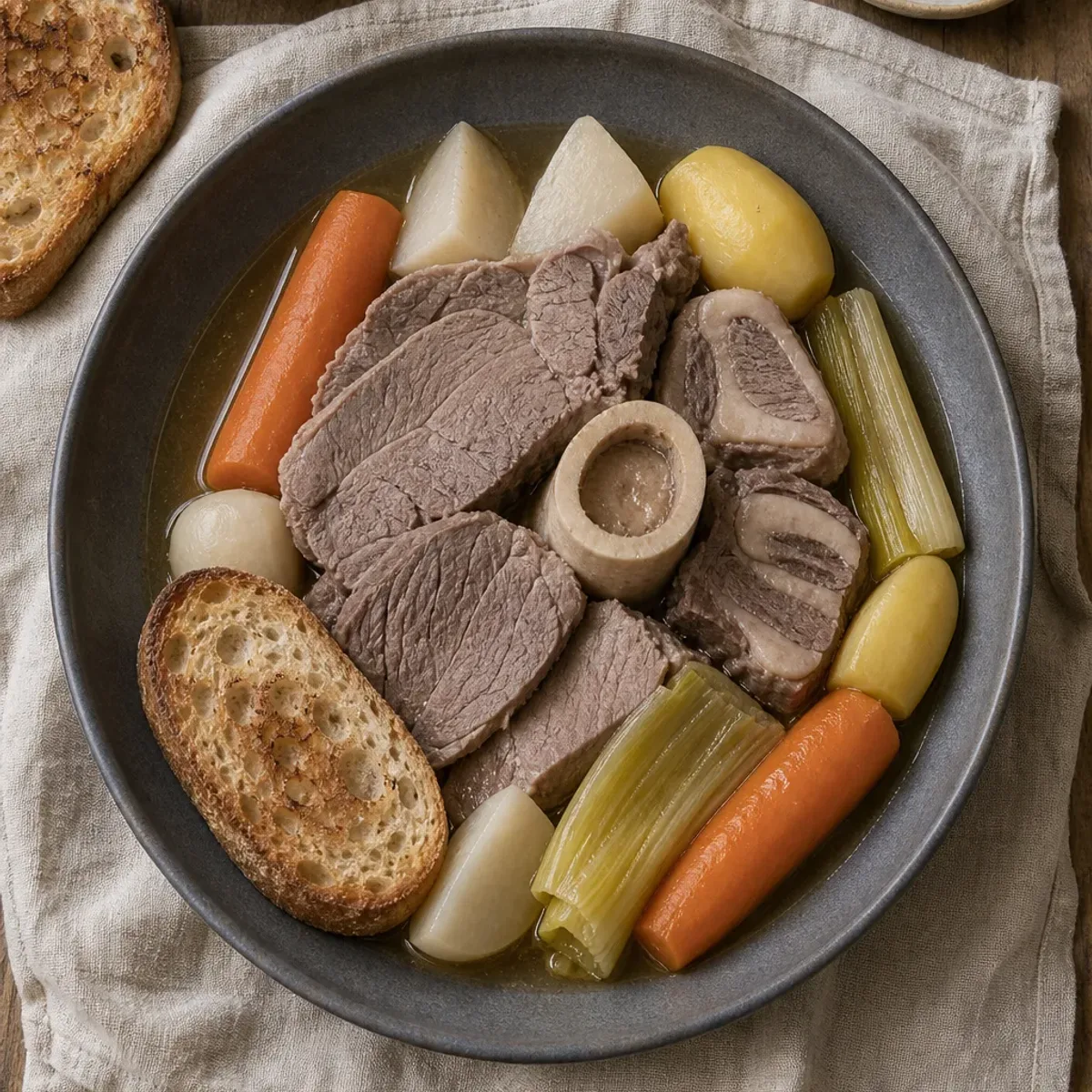
Pot-au-feu
French boiled beef served in two courses: clear bouillon first, then the three beef cuts with marrow bones, vegetables, cornichons, and Dijon mustard.
The meat is slowly brought up to a clear bouillon and then simmers gently, while vegetables, marrow bones, and potatoes are added in stages, so everything arrives at the platter tender and intact. The bouillon is served first, before the sliced meat and accompaniments are set on the table. The gentle simmer is essential for both tender meat and a clear bouillon.
Ingredients
The Meat
- 600 g beef chuck, in one piece
- 600 g short ribs, in one piece
- 500 g beef shank, in one piece, bone-in
- 4 pcs marrow bones, about 5 cm tall
The Bouillon
- 4 l cold water, or enough to cover the meat
- 1 onion, peeled but whole
- 4 pcs whole cloves
- 2 pcs celery, rinsed stalks
- 3 sprig fresh thyme
- 2 leaf bay leaves
- 1 handful parsley stems
- 1 tsp black peppercorns
- 2 tbsp coarse salt
The Vegetables
- 6 pcs carrots, peeled
- 4 pcs turnips, peeled
- 3 pcs leeks, white and light green parts only
The Potatoes
- 800 g waxy potatoes, peeled
- salt, to taste
For the Table
- 8 slice country bread
- 1 jar cornichons, drained
- 4 tbsp Dijon mustard
- coarse sea salt, for the table
How to make it
- Tie the beef chuck and beef shank tightly with kitchen twine so the pieces hold their shape through the long cooking. At the same time, tie the thyme, bay leaves, and parsley stems together into a bouquet garni so the herbs can be fished out again in one go.
The Bouillon
- Place the beef chuck, short ribs, and beef shank in a large pot and cover the meat with the cold water. Bring it slowly to a boil over medium heat, uncovered, skimming off the gray foam with a spoon until the surface looks clear and glossy. The slow heating draws the impurities up into the foam, so the bouillon turns clear instead of cloudy. ⏱ 25 minChef's tip Starting in cold water lets proteins rise and coagulate into skimmable foam before they disperse. Skim before adding vegetables — once aromatics go in, the foam clings to them and is hard to lift cleanly.
- Stick the cloves into the onion and add it to the pot along with the celery, bouquet garni, peppercorns, and coarse salt. Turn down the heat until the water just barely simmers with the occasional bubble here and there. If it boils harder, the meat will turn stringy and the bouillon cloudy.Chef's tip Aim for around 85–90 °C: a lazy bubble breaking every few seconds at the edge, never a rolling surface. Hard boiling emulsifies fat into the liquid and clouds it permanently — no straining brings that back.
The Meat
- Put the lid on halfway and let the meat simmer gently for 2 hours, until a fork slides into the edge of the shank without resistance, but the meat still holds together. ⏱ 2 h · passiveChef's tip The lid half on keeps the pot from stalling below a simmer while still letting steam escape. A sealed lid traps heat and pushes the pot into a boil you can't see coming.
The Vegetables
- Meanwhile, cut the turnips into wedges and leave the carrots whole. Slit the leeks lengthwise, rinse the dirt out between the layers, and tie them together into a bundle with kitchen twine so they don't fall apart in the pot. ⏱ 15 min
- Add the carrots and turnips to the simmering bouillon and let them cook along for 30 minutes, until they're tender all the way through but still hold their shape when you lift one out. ⏱ 30 min · passive
- Place the leek bundle and marrow bones on top of the meat and vegetables in the pot, and let everything simmer for another 20 minutes, until the marrow is glossy and releases from the bone with a light press. The marrow bones go in last, since longer cooking would melt the marrow out into the bouillon. ⏱ 20 min · passive
The Potatoes
- Put the potatoes in a smaller pot and ladle bouillon from the large pot over them until they're just covered. Cook them for 25 minutes, until a knife slides easily into the center, seasoning the cooking liquid with salt along the way. They cook separately because their starch would otherwise cloud the clear bouillon. ⏱ 25 min · passive
For the Table
- Toast the eight slices of country bread golden and crisp in a dry pan. Four slices go with the bouillon, and four are set aside for the marrow.
The Bouillon
- Lift the meat, marrow bones, carrots, turnips, and leek bundle out of the pot with a slotted spoon and keep them warm under a piece of foil. Skim the fat off the bouillon with a spoon. Strain a liter of it through a fine sieve and season with salt so it tastes round and full-bodied.Chef's tip Foil on its own dries the meat out. Better to ladle a little hot bouillon over the pieces, or let them sit in a bowl of bouillon — that way they stay juicy and the cut surface doesn't go gray and dry.
For the Table
- Ladle the strained bouillon into deep bowls and serve it as the dish's first course, with a slice of toasted bread for each.
- Then slice the meat you've been keeping warm into thick slices across the grain and arrange them on a large warm platter with the carrots, turnips, leeks, potatoes, and marrow bones around them. Set the coarse sea salt, cornichons, and Dijon mustard on the table, so everyone salts their own meat, scrapes the marrow onto their toasted bread, and helps themselves to more from the platter.