Pizza Bianca
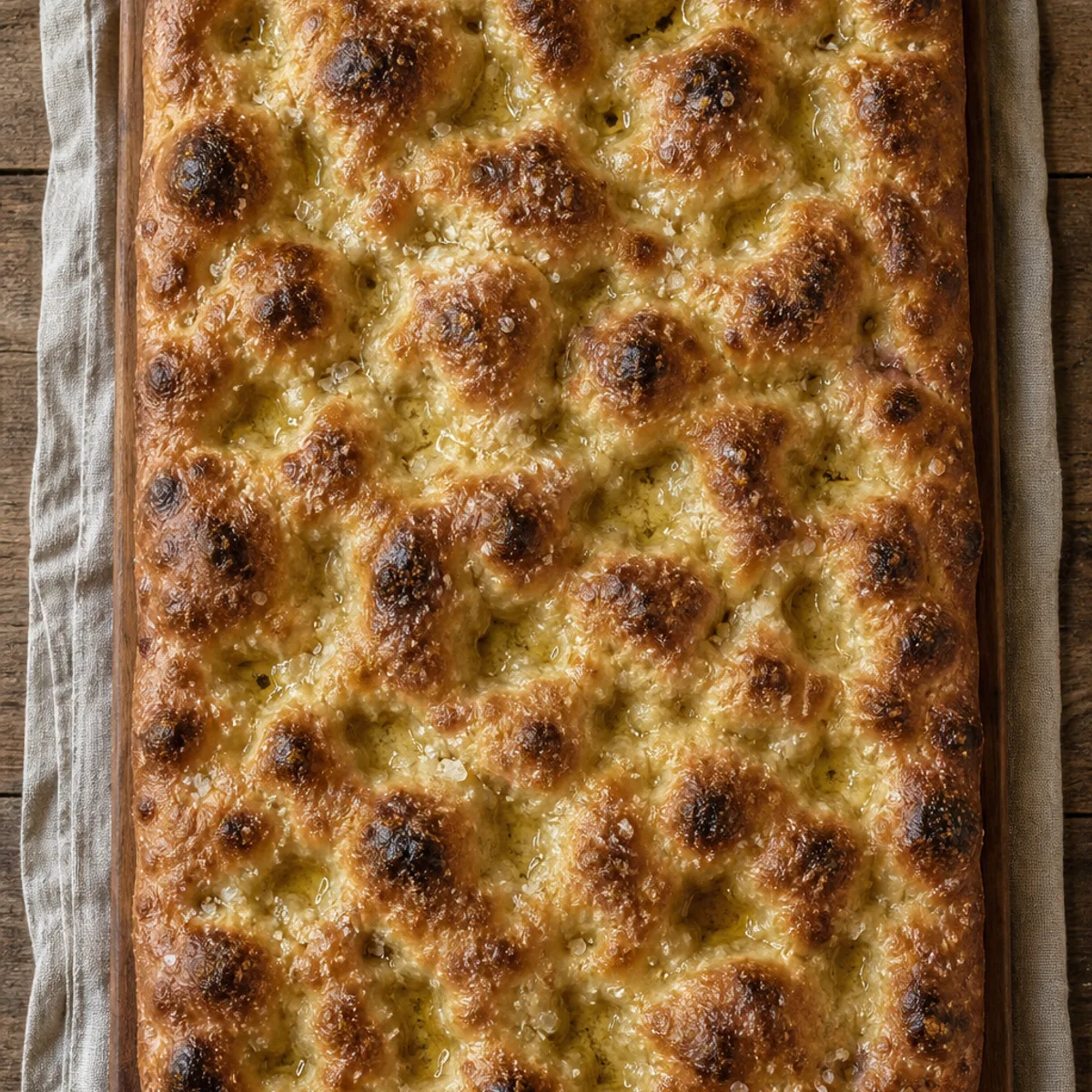
Roman flatbread without tomato — a very wet dough is pressed into a baking pan, dimpled deep with your fingers, and baked with olive oil and coarse salt.
The dough is built up through rest, folding, and a long cold rise, before it gets time to turn soft and bubbly in the pan. While the dough comes to temperature, the oven needs to heat through thoroughly, and the pizza proofs one last time before oil, dimples, and baking. The thoroughly heated oven determines whether the base turns crisp without the crumb drying out.
Ingredients
- 600 g tipo 0 wheat flour
- 4½ dl water, lukewarm
- 5 g fresh yeast
- 15 g fine sea salt
- 1 dl olive oil, extra virgin
- 1 tsp coarse sea salt
How to make it
- Stir the fresh yeast into the lukewarm water in a large bowl until the liquid is evenly cloudy and completely free of lumps. Add the flour and stir with a dough scraper until no dry flour remains at the bottom. The dough should be sticky and uneven at this point — it won't turn smooth until later.Chef's tip Lukewarm means hand-warm, around 30-35°C. If the water is hotter than about 45°C, the yeast is damaged, and the dough rises sluggishly despite the long day in the cold.
- Cover the bowl with a damp kitchen towel and let the dough rest for 20 minutes. It's ready when the surface is glossy and wet and the dough hangs in long strands from your fingers when you lift it. The flour absorbs the water during the rest, and that's what makes it possible to work with the very wet dough. ⏱ 20 min · passiveChef's tip This is roughly 75% hydration, so the stickiness is correct — do not rescue it with extra flour. It loses its shagginess through resting and folding, and flour added now costs you the open crumb.
- Sprinkle the fine sea salt over the dough and add 2 tbsp of the olive oil. Squeeze the dough through your fingers and fold it over itself in the bowl for 5 minutes, until you can no longer feel the salt grains and the dough is glossy, elastic, and comes away from the sides of the bowl in one piece.Chef's tip The dough turns looser and wetter the moment the salt goes in — that's normal, and it passes after a couple of minutes of folding. Never add flour here; it's the salt that tightens up the gluten network.
- Fold the dough with a wet hand: grab an edge, pull it upward, and lay it over the center. Then turn the bowl a quarter turn. Repeat eight times, until the dough tightens up and keeps holding its round shape instead of spreading out. Cover the bowl tightly and place it in the refrigerator (see Advance Prep).
- Take the bowl out of the refrigerator and let the cold-risen dough stand covered at room temperature for 90 minutes. It's ready when it has visibly grown, is full of bubbles just under the surface, and no longer feels cold to the touch. Cold dough contracts again as soon as you let go of it. ⏱ 1 h 30 min · passiveChef's tip You're aiming for the dough to reach about 18-20°C right through, not just on the surface — press a finger in and it should feel neutral, not chilly. Cold at the core tears at the corners when you stretch it.
- Preheat the oven to 275°C, or the highest temperature it can reach, with the rack in the lowest third. Let the oven heat through for 30 minutes, until it's thoroughly hot all the way around. Pizza bianca needs strong bottom heat from the very first minute, or it will dry out before it has a chance to turn golden. ⏱ 30 min · passiveChef's tip The oven signals its target temperature long before the walls and rack have absorbed the heat, and it's that stored heat that hits the base. The full 30 minutes past the beep is the difference between crisp and pale underneath.
- Pour 2 tbsp of the olive oil into a baking pan about 30 × 40 cm and spread the oil all the way into the corners with your hand. Turn the dough out into the pan without knocking the air out of it. Gently stretch the dough from the center toward the corners with your fingertips, until it covers the whole pan in an even, soft layer. ⏱ 10 minChef's tip Those bubbles under the surface are the crumb — tip the bowl and let the dough fall out in one piece rather than scraping or pressing. If it springs back and won't reach the corners, wait 10 minutes and stretch again.
- Lay a kitchen towel over the pan and let the dough proof for 30 minutes, until it has visibly puffed up and jiggles softly when you shake the pan. ⏱ 30 min · passive
- Press your fingertips straight down into the dough all the way out to the edges, leaving deep dimples right down to the pan. Drizzle 2 tbsp of the olive oil over the top and sprinkle the coarse sea salt evenly over the whole surface. The dimples hold the oil so it bakes into the bread instead of running off to the side.Chef's tip Press all the way down to the pan and all the way out to the edge. Any spot you skip puffs up into one big dome that leaves a hollow under the crust.
- Bake the pizza on the bottom rack of the hot oven for 13-15 minutes. It's done when the surface is golden brown with dark blisters on top and the base is crisp and releases from the pan when you lift the edge with an offset spatula. ⏱ 15 min · passive
- Drizzle the remaining olive oil over the freshly baked pizza bianca while it's still steaming — the warm crumb soaks up the oil instead of letting it sit on top as a film. Lift the bread onto a wire rack and let it stand for 5 minutes so the base doesn't turn soft from its own steam. ⏱ 5 min · passive
- Cut the pizza into oblong pieces with kitchen scissors and place them on a wooden board. It's eaten warm and with your fingers — split a piece lengthwise and fold it in on itself so the crumb holds on to the heat.