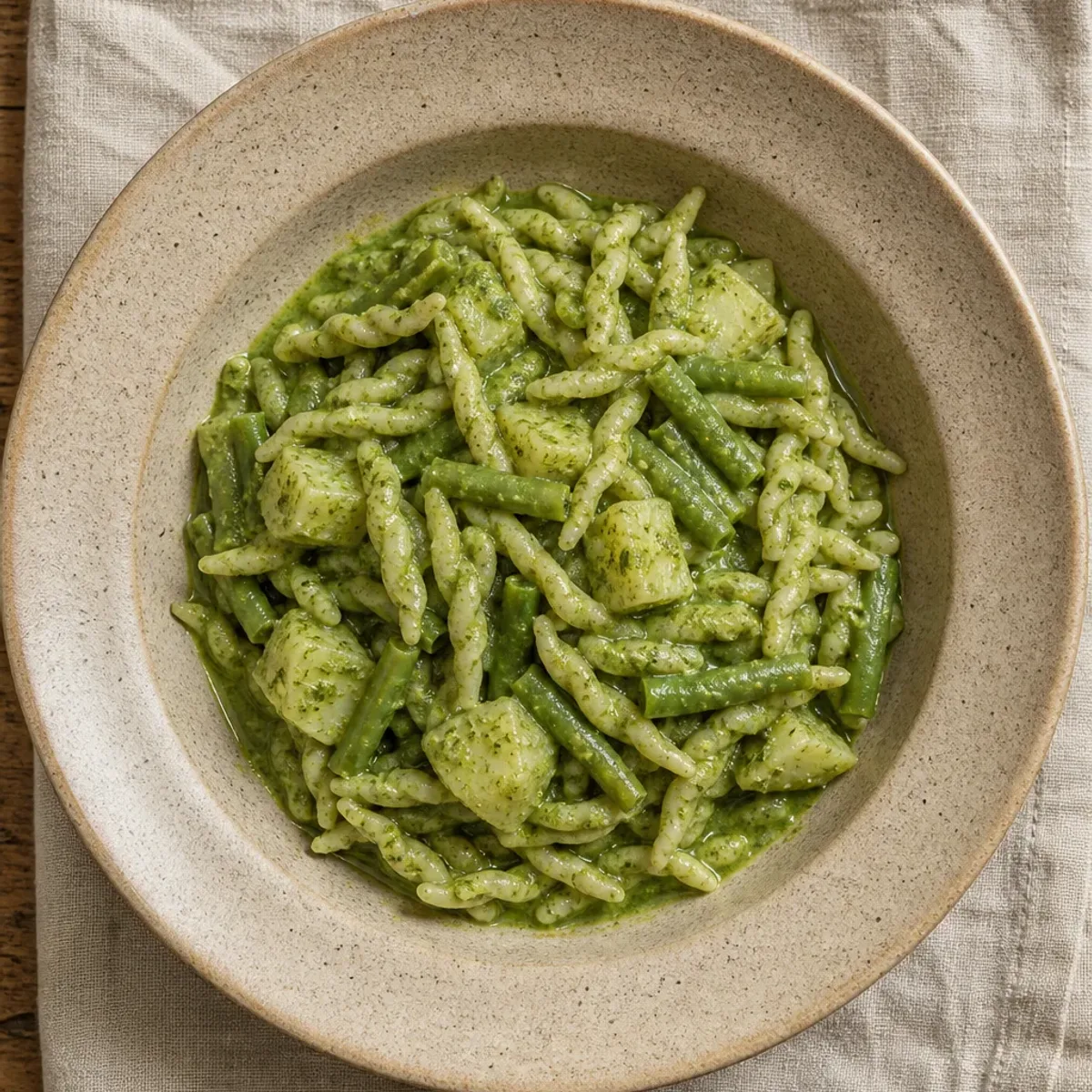
Pasta al Pesto
A Ligurian pasta dish where trofie is cooked together with potatoes and green beans, and the pesto is pounded in a mortar with basil and pine nuts.
While the potatoes get a short head start in the cooking water, the pesto is slowly built into a dense, green cream and only loosened just before the pasta is done. Everything comes together warm in the bowl, so the trofie, beans and potatoes get a glossy green sauce without the basil losing its freshness. The pesto must never be heated directly, since that determines both its color and flavor.
Ingredients
The Pesto
- 50 g fresh basil, leaves only, no stems
- 2 clove garlic
- 1 tsp coarse salt
- 30 g pine nuts
- 70 g Parmigiano Reggiano, freshly grated
- 30 g pecorino fiore sardo, freshly grated
- 1 dl extra virgin olive oil
The Pasta
- 500 g trofie, dried
- 250 g potatoes, peeled and cut into 1.5 cm cubes
- 200 g green beans, trimmed and halved
- salt, for the cooking water
How to make it
The Pesto
- Rinse the basil leaves gently in cold water and pat them completely dry in a clean cloth. Not a single drop of water should remain, as water will cause the pesto to split and taste flat.Chef's tip Bruise the leaves as little as possible while drying — pat, don't rub. Leaves that go into the mortar torn or blackened at the edges have already started oxidising, and that dulls the green before you begin.
- Pound the garlic cloves together with the coarse salt in the mortar until you have a smooth, white paste with no visible pieces. The salt crystals act as an abrasive and speed up the work.Chef's tip The garlic has to be ground down completely before the basil goes in. Any pieces left behind won't break down later, and you'll get sharp bites of raw garlic in an otherwise rounded pesto.
- Add the basil leaves to the mortar a handful at a time, turning the pestle against the wall of the mortar instead of pounding straight down. The turning motion tears the leaves apart rather than crushing them, so the color holds. Keep going until no whole leaves remain and the mixture is an even, grass-green cream.
- Add the pine nuts and pound them into the basil mixture. It should become thick and rich, and should no longer feel grainy when you draw the pestle against the wall of the mortar.
- Stir the freshly grated Parmigiano Reggiano and pecorino into the mixture. Then thin it with the olive oil in a thin stream while stirring with the pestle. Keep going until the pesto is glossy and just barely drips off the spoon. Season to taste with salt — the cheeses are quite salty, so the pesto rarely needs more.Chef's tip Add the oil in a thin thread, not a splash — poured too fast it sits in a separate slick instead of blending in, and the sauce looks broken rather than glossy. The pesto should coat the pestle in an even film.
The Pasta
- Bring a large pot of water to a boil and salt it so it tastes distinctly of salt. ⏱ 8 min · passiveChef's tip Use plenty of water for 500 g of pasta and salt it to roughly 10 g per litre — with potatoes releasing starch into the same pot, a stingy amount of water turns gluey and the trofie stick to each other.
- Add the potato cubes to the boiling water and cook them for 5 minutes. They get a head start so they become tender at the same time as the pasta. ⏱ 5 min · passive
- Add the beans and the trofie to the same pot, and continue cooking for 10-12 minutes. The pasta should be al dente with a little resistance at the center, and the potato cubes should be easy to break apart with the edge of a spoon. ⏱ 10 min · passive
The Pesto
- Ladle out 1 dl of the cooking water and rinse a large serving bowl with a bit of it so the bowl gets warm. Then stir 2-3 tablespoons of the water into the pesto until it's thin enough to slip down between the pasta. Never heat the pesto over the burner — cooked pesto turns bitter and dark.
- Pour the pasta, potatoes and beans into a colander and let them drain for a moment. Toss them immediately in the bowl with the thinned pesto until every single piece of trofie is coated in a glossy, green sauce. Thin with more of the reserved cooking water if the sauce clings and clumps.Chef's tip Drain briefly and leave the pasta wet — don't shake it dry or rinse it. A film of clinging water carries the pesto into every groove of the trofie; bone-dry pasta makes the sauce clump in patches.
- Divide the pasta among deep plates and serve immediately, while the aroma is still sharp with basil. The pesto loses both color and freshness if the dish sits and waits.