Galette Complète
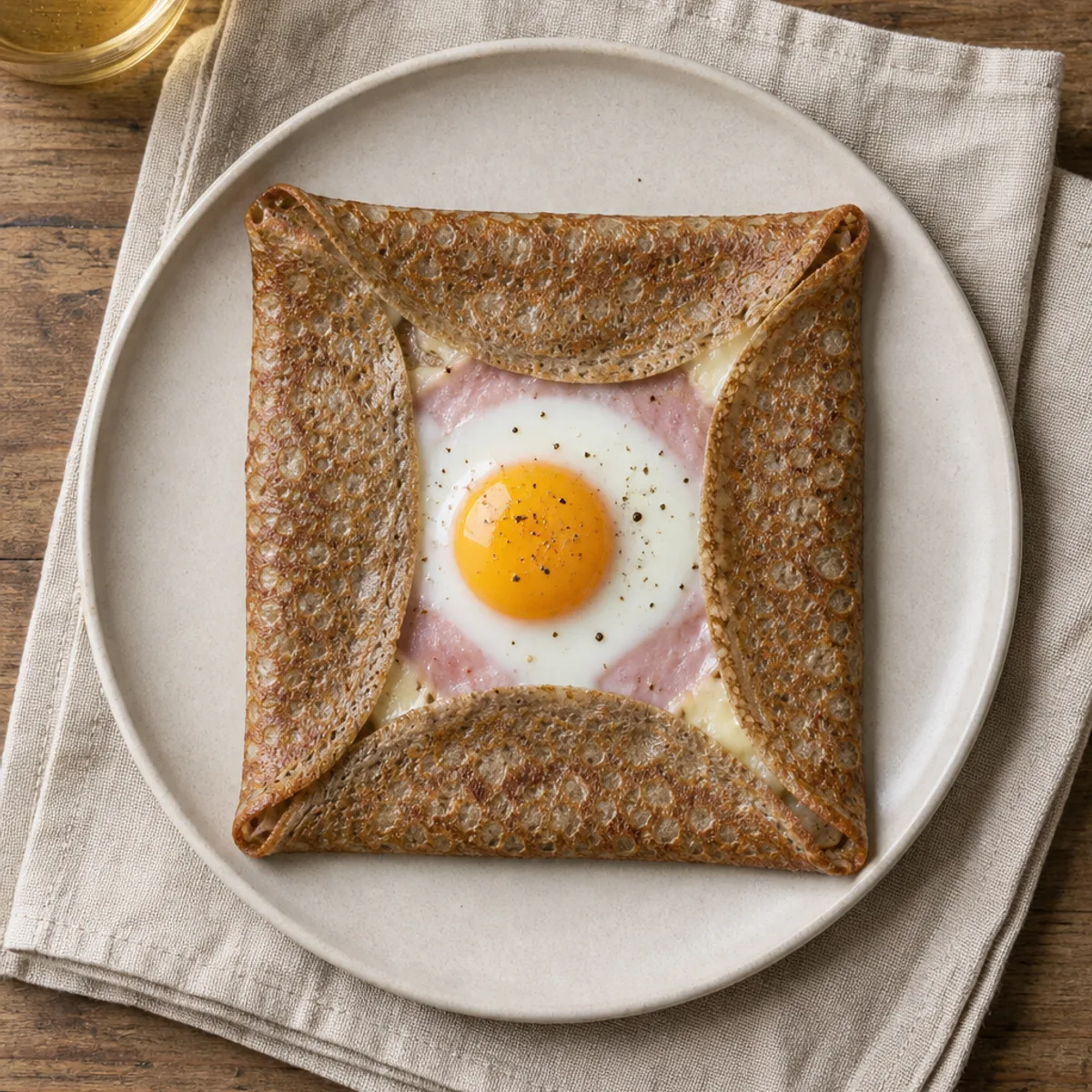
Breton buckwheat pancake folded around ham, emmental and a whole fried egg, traditionally served with cold cider in a bowl.
The batter is made the day before and stirred back together, while the hot pan is first calibrated with a test galette. From there it proceeds at a calm but unbroken pace, one filled galette at a time, served the moment it's ready. The right pan temperature determines whether the galette turns thin and crisp without sticking.
Ingredients
The galette batter
- 200 g buckwheat flour
- 5 dl water, cold
- 1 tsp coarse sea salt
The filling
- 40 g salted butter
- 200 g emmental, grated
- 4 slice cooked ham, thick
- 4 eggs
- freshly ground pepper
To serve
- 7½ dl brut cider, cold
How to make it
The galette batter
- Whisk the buckwheat flour together with half of the water into a thick, lump-free batter. Beat the batter vigorously by hand or with a whisk until it turns glossy and falls from the spoon in ribbons — it's the air that makes the galette pliable enough to fold. Stir in the rest of the water and the coarse sea salt, cover the bowl, and refrigerate (see Advance Prep). ⏱ 10 minChef's tip Buckwheat has no gluten, so the 12-hour rest is what does the softening: the flour swells fully and the batter turns smooth and supple. A rushed batter tears at the edges when you fold it.
- Stir the rested batter thoroughly, since the buckwheat flour will have settled into a layer at the bottom. It should run thinly off the spoon like heavy cream. Thin it with a couple of tablespoons of cold tap water if it has thickened during resting.Chef's tip Thin it a tablespoon at a time — you can't take the water back out. Too thin a batter gives the galette holes and it tears when you flip it; it should just barely veil the back of the spoon.
- Set the flat crêpe pan over medium-high heat and let it heat through for 5 minutes. The pan is ready when a drop of water dances across it and evaporates instantly. ⏱ 5 min · passiveChef's tip A drop that sizzles, creeps and lingers means the pan is still short of about 200 °C. Batter poured onto an under-heated pan grips the metal instead of setting on contact, and the galette tears when you lift it.
- Rub the pan with a paper towel dipped in the salted butter, pour about 1 dl of batter into the center, and immediately spread it into a thin, even circle with the rozell or offset spatula. Cook the test galette for 2 minutes, until the edges dry out and release from the pan on their own. Use the test galette to find the right heat — the first galette is always a trial.Chef's tip You have a few seconds before the batter sets — spread it the moment it lands, or the rozell drags furrows into a skin that has already caught. Keep the butter film barely visible; pooled butter makes the batter skate instead of grip.
- Rub the pan with butter again and pour in about 1 dl of batter. Spread it into a thin circle and cook the galette for 2 minutes, until the surface is matte and dry and the underside is speckled light brown. Flip it with the offset spatula.Chef's tip The second side only has to carry the filling, so it needs no colour of its own. Left too long it dries through and the galette cracks along the folds instead of bending into a square.
The filling
- Place a couple of cubes of the salted butter on the flipped galette and let them melt out clear over the center. Sprinkle on about 50 g of grated emmental, lay a slice of cooked ham on top of the cheese, and crack an egg into the middle of the ham. Give the egg a little freshly ground pepper — the cheese and ham salt it plenty on their own.
- Fold the four sides in over the filling into a square, so the yolk sits exposed in the center. Turn down to medium heat and continue cooking for 3-4 minutes. The galette is done when the white is milky white and set, the cheese has melted down under the ham, and the yolk still gives to the touch.Chef's tip Put a lid over the pan for the last minute if you like: the steam sets the white from above without the bottom scorching, while the yolk still runs. Glossy, translucent white around the yolk isn't set yet.
- Cook and fill the remaining three galettes the same way, one at a time. Stir the batter between each galette, and rub the pan with butter again so the next one doesn't stick. ⏱ 20 min
To serve
- Slide each galette onto a warm flat plate as soon as it's ready, and bring it to the table immediately — it turns rubbery if it waits. Pour the cold brut cider into shallow bowls or cups. The galette is eaten with a knife and fork: first cut into the white near the yolk, so the yolk runs out over the ham and cheese, then work outward from there toward the crisp corners.