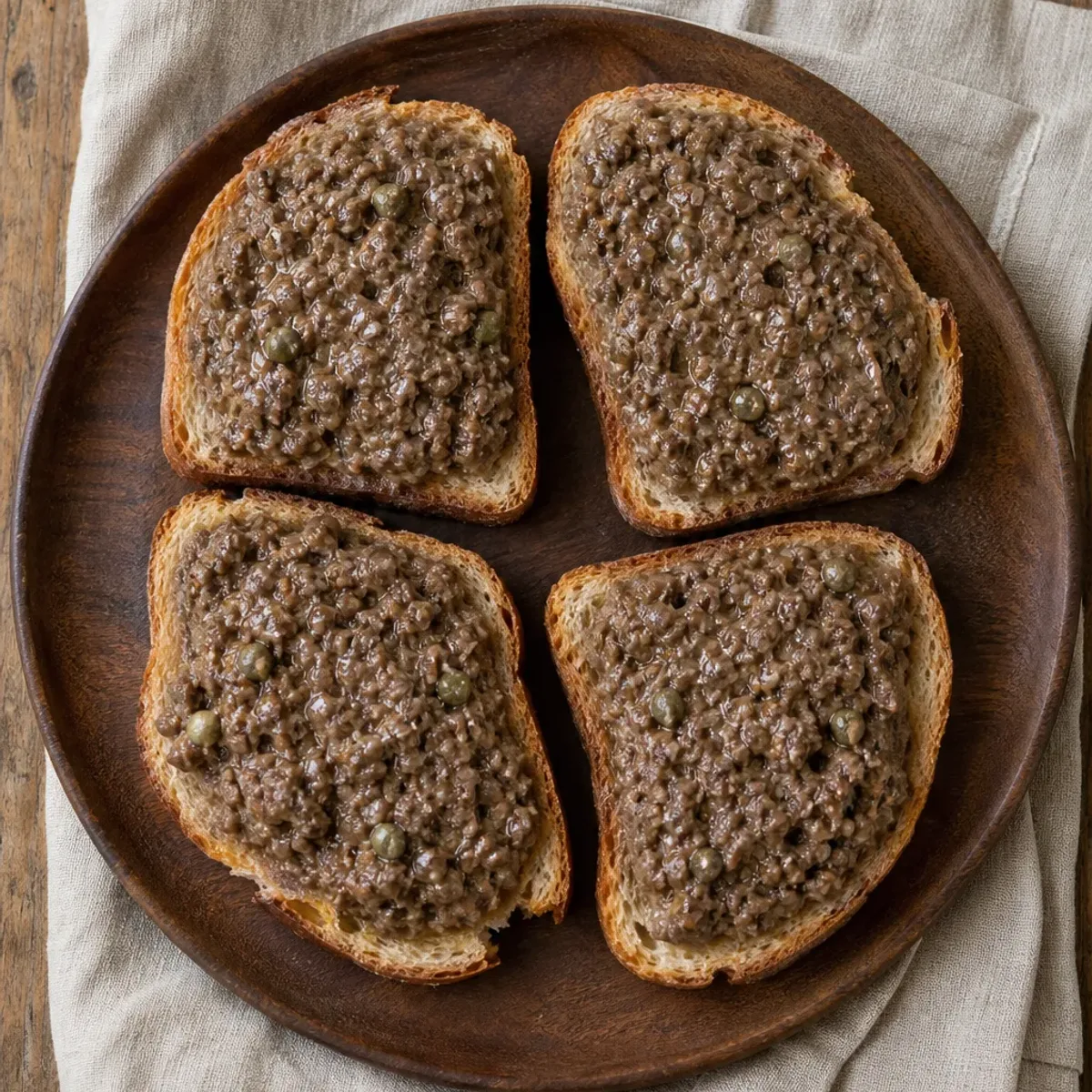
Crostini
A Tuscan appetizer of chicken liver simmered in vin santo with anchovy and capers, coarsely chopped and spread on toasted bread dipped in broth.
The onions need to turn sweet and translucent first, before the liver is browned, finished cooking in the concentrated pan juices, and coarsely chopped into the rustic crostini neri cream. Meanwhile the bread can be toasted, and just before serving it's briefly dipped in hot broth and given a generous layer of warm liver cream. The brief dipping of the bread determines the balance between a moist crumb and a crisp edge.
Ingredients
The liver cream
- 400 g chicken liver
- 1 onion, finely chopped
- 2 tbsp olive oil
- 40 g butter
- 1 dl vin santo
- 4 pcs anchovy fillets, in oil
- 1 tbsp capers, drained
- 3 dl chicken broth
- salt
- pepper, freshly ground
The bread
- 16 slice pane toscano, unsalted, about 1 cm thick
How to make it
The liver cream
- Rinse the chicken livers briefly under cold water and pat them completely dry. Trim away the greenish bile spots and the white membranes with a small knife, because they make the cream bitter. Cut the livers into large chunks.Chef's tip The livers should feel matte and dry, not glossy, before they hit the pan. Any water on the surface has to boil off first, and while it does the liver steams instead of browning.
- Warm the olive oil and half the butter in a wide pan over low heat. Let the finely chopped onion sweat for 10 minutes, until completely soft and translucent without taking on color — a browned onion gives the liver cream a harsh, bitter edge. ⏱ 10 minChef's tip Listen for a faint sizzle, not a crackle: at the right heat the onion releases steam and turns glassy. If the edges start to color, pull the pan off and add a spoonful of broth.
- Turn the heat up to medium-high and add the liver pieces to the pan in a single layer. Brown them for 5 minutes, turning only a few times, until they are grayish-brown all over and the raw, glossy surface is gone.Chef's tip Crowding drops the pan temperature and the livers release liquid and stew instead of browning. Work in two batches if the pieces touch — you want to hear a steady sizzle throughout.
- Pour in the vin santo and let it reduce for 3 minutes. The pan should be nearly dry, and the sharp alcohol smell should be replaced by a sweetish aroma.
- Add the anchovy fillets and capers to the pan and mash the anchovies into the fat with the back of a spoon, until fully dissolved. Add 2 dl of the chicken broth and let it simmer over low heat for 15 minutes, until the livers are cooked through with no pink center and the liquid has reduced to a thick, glossy sauce. ⏱ 15 minChef's tip Only lazy bubbles should rise along the edge. If it boils too hard, the protein in the liver tightens up and the cream turns dry and grainy instead of soft.
- Lift the livers onto a cutting board with a slotted spoon and chop them coarsely with a heavy knife. The mixture should be evenly coarse with small visible pieces — crostini neri has bite and is never a smooth mousse.
- Stir the coarsely chopped liver back into the pan with the sauce and the remaining butter. Heat it through for 2 minutes, until the cream is glossy and just barely slides heavily off the spoon. Season with salt and freshly ground pepper. Go easy on the salt, since the anchovies and capers have already salted the mixture.Chef's tip Add the butter off the boil and stir it in gently — the residual heat is enough to melt it into the sauce for gloss. Hard boiling at this point can split the fat out into a greasy film.
The bread
- Toast the bread slices in two batches in a dry pan over medium heat. Give them 8 minutes total, until dry and golden with crisp edges.
- Heat the remaining chicken broth and dip one side of each toasted slice into it briefly, so the bread becomes moist without turning soggy. Spread the warm liver cream in a thick layer on the dipped side.Chef's tip Count one to two seconds, no more — unsalted Tuscan bread is thirsty and goes limp fast. The surface should look darkened and damp, not dripping when you lift it.
- Arrange the crostini in a single layer on a wooden board and place the board in the center of the table while they are still warm. They are picked up with the fingers and eaten right away — if they sit and wait, the bread soaks up moisture and turns soft, and the crisp edge disappears.