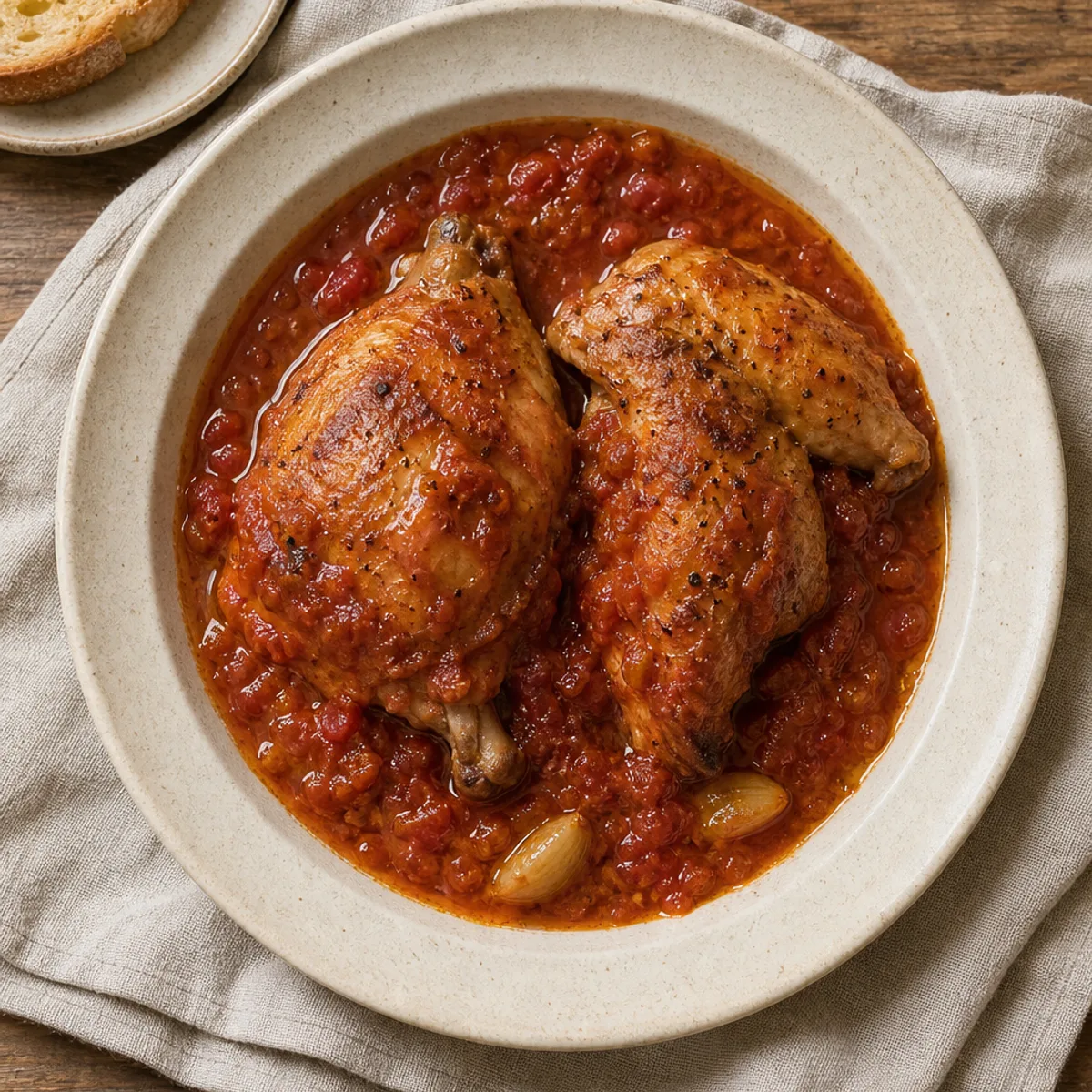
Chicken Cacciatore
An Italian hunter's dish where chicken pieces are braised in white wine and tomato with rosemary and sage, served with toasted bread for the sauce.
The chicken first gets a deep sear before onion, herbs and wine build the sauce around it. It simmers tender under the lid, then the bread can be toasted at the end while the sauce finishes down to a glossy, thick consistency. The deep browning of the chicken skin determines the depth of the dish.
Ingredients
The chicken
- 2 kg whole chicken, cut into 8 pieces
- 5 tbsp olive oil, extra virgin
- 1 onion, finely chopped
- 3 clove garlic, lightly crushed with the flat side of a knife
- 2 sprig rosemary
- 6 leaf fresh sage
- 2 dl dry white wine
- 400 g peeled tomatoes
- salt
- black pepper, freshly ground
To serve
- 4 slice country bread, about 1 cm thick
- 1 tbsp olive oil
- 1 pinch salt
How to make it
The chicken
- Pat the chicken pieces completely dry with paper towels. Season them on all sides with salt and freshly ground black pepper. The skin needs to be dry, or it will steam instead of browning.Chef's tip Salting just before browning is fine, but salt drawn to a wet surface has to boil off before the skin can colour. If the towel comes away damp, dry it again — visible sheen means steam.
- Heat the olive oil in a wide, heavy pot over medium-high heat. Brown the chicken pieces in two batches, skin-side down first, 8-10 minutes per batch. They're ready when the skin is deep golden and releases from the bottom on its own. Don't fill the pot completely, as an overcrowded layer lowers the heat, causing the meat to boil instead of sear. Transfer the pieces to a platter. ⏱ 15 min–20 minChef's tip Don't move the pieces while they brown — the crust releases itself once formed, and prying early tears the skin off into the pot. Listen for a steady sizzle; if it goes quiet, the pan has cooled and the skin is stewing.
- Turn the heat down to medium and sauté the finely chopped onion, crushed garlic cloves, rosemary sprigs and sage leaves in the rendered fat for 5 minutes, until the onion is soft and glossy and the herbs smell resinous.Chef's tip Turn the heat down before the aromatics go in — the pot is still fierce from searing, and garlic scorched in hot fat turns bitter in a way the long simmer won't cover. Whole crushed cloves resist this better than chopped.
- Pour in the white wine and scrape the bottom clean with a wooden spoon while the wine reduces for 4 minutes. It's cooked enough when the sharp wine smell is gone and the liquid has reduced by half.
- Crush the peeled tomatoes between your hands into the pot and salt the sauce. Return the browned chicken pieces along with any juices that have collected on the platter, and bring to a boil for 3 minutes, until the sauce bubbles evenly around the meat.
- Cover with a lid and turn the heat down to the lowest setting, where the sauce still bubbles lazily. Let the chicken simmer for 40 minutes. The meat is done when it's tender and pulls away from the bone with a gentle tug, and the thigh reads 75°C at the core. ⏱ 40 min · passiveChef's tip Keep it at a bare bubble, a few surfacing every second. A hard boil tightens the breast into dry strings well before the thigh reaches the tender, falling-from-bone stage this dish wants.
- Remove the lid and let the sauce reduce for 10-12 minutes, turning the pieces in it a couple of times. It's thick enough when it clings as a layer around the meat and the olive oil beads clear at the edge of the pot. ⏱ 10 min
To serve
- Brush the bread slices with the olive oil for serving and sprinkle them with a pinch of salt. Toast them in a dry skillet over medium-high heat for 4 minutes, until golden and crisp on the crust but still soft in the middle.Chef's tip The skillet needs to be hot before the bread goes in — on a lukewarm pan the slices just dry out into crackers instead of getting a golden crust with a soft middle.
- Fish the rosemary sprigs and sage leaves out of the pot. Divide two chicken pieces per person among deep plates, and ladle plenty of sauce over top. Set the toasted bread on the table, and let everyone wipe their plate clean with it at the end — that's how the sauce is meant to be eaten.