Bolognese Sauce
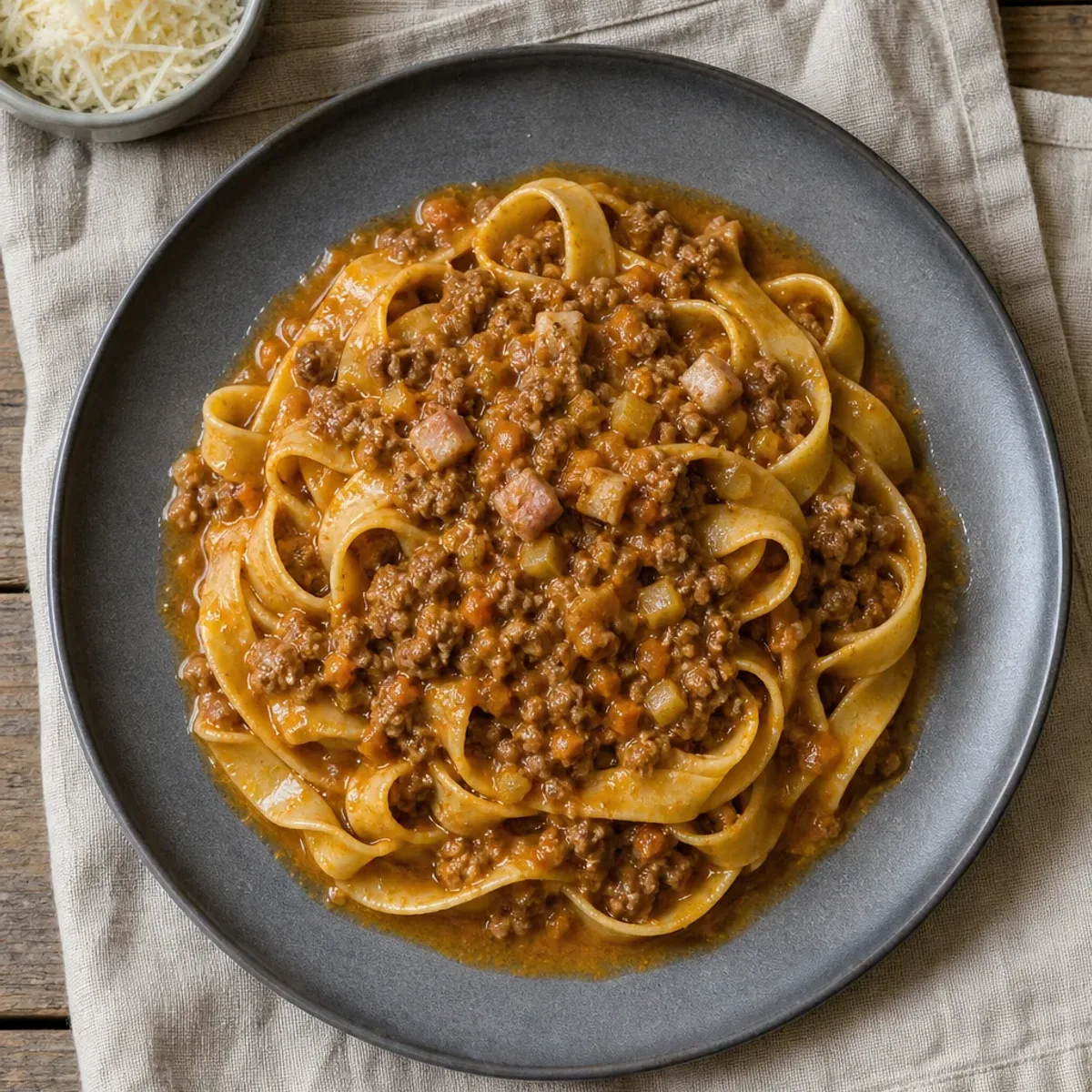
An Emilian meat sauce where pancetta and finely chopped soffritto simmer with beef for hours, rounded out with milk and served over egg tagliatelle.
The pancetta is rendered slowly, the vegetables turn into a sweet soffritto, and the meat is browned dry before wine and tomato build up the sauce. The ragù then needs to simmer for a long time, with milk added toward the end, while the tagliatelle is cooked and tossed in only just before serving. The almost imperceptible simmer determines whether the meat turns out juicy and tender.
Ingredients
The Ragù
- 250 g fresh pancetta, in small dice, not smoked
- 3 tbsp extra virgin olive oil (or 50 g butter)
- 70 g onion, finely chopped
- 90 g carrot, finely chopped
- 90 g celery, finely chopped
- 600 g beef chuck, coarsely chopped
- 1½ dl dry white wine (or red wine)
- 400 g passata
- 5 dl light meat stock (or bouillon cube)
- 2 dl whole milk
- 1 pinch nutmeg, freshly grated
- salt
- black pepper, freshly ground
To serve
- 600 g fresh egg tagliatelle, from the refrigerated section
- 2 tbsp salt, for the pasta water
- 80 g Parmigiano Reggiano, freshly grated
How to make it
The Ragù
- Finely chop the onion, carrot, and celery with a knife on a cutting board until the pieces are the size of rice grains. Skip the food processor — it shreds the vegetables into a watery mush that cooks away to nothing instead of giving the ragù body. ⏱ 10 min
- Render the diced pancetta in the olive oil in a heavy-bottomed pot over medium-low heat. It's ready when the fat has rendered out clear and the dice are glossy and still pale, without having taken on any color.Chef's tip Starting the pancetta in cool-to-warm oil rather than a hot pan gives the fat time to melt out before the meat firms up. Listen for a soft, low sizzle — sharp crackling means it's browning and turning tough.
- Add the onion, carrot, and celery to the pot and sauté gently over medium-low heat for 15 minutes, stirring occasionally. The vegetables should collapse completely and turn soft and glossy. The onion must not get browned edges, since scorched onion gives a bitterness that won't cook away in three hours. ⏱ 15 min
- Turn the heat up to medium, add the coarsely chopped beef chuck, and break it apart with a wooden spoon so it doesn't clump. Cook until all the liquid has evaporated and the meat is sizzling in the fat instead of boiling. Season with salt and pepper. ⏱ 10 minChef's tip Salt the meat now rather than at the end — salt added early has the whole simmer to work into the pieces, and coarse-chopped chuck seasoned only at the table tastes bland inside.
- Pour in the white wine and let it evaporate completely over medium heat. Wait until the sharp smell of wine is gone and all you can smell is meat and vegetables. If the tomato goes in before that, it locks the acidity into the ragù for the rest of the cooking time.
- Stir in the passata and let it cook along for 5 minutes, until the raw red color turns into a deep orange and coats the meat.
- Add 3 dl of the meat stock and put the lid on the pot. Turn the heat down to the lowest setting, where the ragù is only just blipping, and let it cook for 90 minutes. The lid and the low heat hold on to the moisture, so the meat has time to become tender instead of reducing itself dry. ⏱ 1 h 30 min · passiveChef's tip Just below a boil — one bubble every couple of seconds — the connective tissue in the chuck melts slowly into gelatin, and that's what gives the ragù its body. At a real boil the meat fibers seize up and go stringy, no matter how much liquid is standing in the pot.
- Stir in the whole milk and the freshly grated nutmeg, and add the remaining stock if the ragù has settled heavily on the bottom. Put the lid back on and let it keep cooking for 45 minutes, until the meat falls apart against the spoon and the ragù is dark orange, creamy, and enveloping. ⏱ 45 min · passive
- Taste the ragù for salt and pepper. Hold back slightly on the salt, since the grated Parmigiano Reggiano at the table will season it again.
- Set 4 liters of water to boil in a large pot with the lid on and bring it to a rolling boil. ⏱ 10 min · passive
- Salt the water with the 2 tbsp salt, add the tagliatelle, and stir right away so the strands don't stick together. Cook for 3 minutes, until al dente — bending softly without being tender all the way through. Reserve 1 dl of the cooking water before you pour the pasta into a colander.Chef's tip Fresh egg pasta goes from al dente to soft in under a minute, so start tasting at two minutes. The strands should still have a firm line down the middle — they keep cooking in the hot ragù.
- Toss the freshly cooked tagliatelle into the ragù in the pot over low heat for 2 minutes, until every strand is coated and glossy. If the ragù is too thick for the pasta to move freely, loosen it with a splash of the reserved cooking water.Chef's tip Finishing the pasta in the pot lets the strands absorb sauce and release starch, so the ragù clings instead of pooling underneath. The starchy cooking water is the tool here — plain water thins the sauce without binding it.
To serve
- Divide the tagliatelle among shallow, wide plates, and spoon whatever ragù is left in the pot over the strands. Put the freshly grated Parmigiano Reggiano on the table in a bowl, so everyone sprinkles their own portion, and eat right away while the ragù is hot.