Bistecca alla Fiorentina
Tuscan T-bone steak, ideally from Chianina cattle, thickly cut and grilled rare over charcoal, salted only afterward and served with cannellini beans.
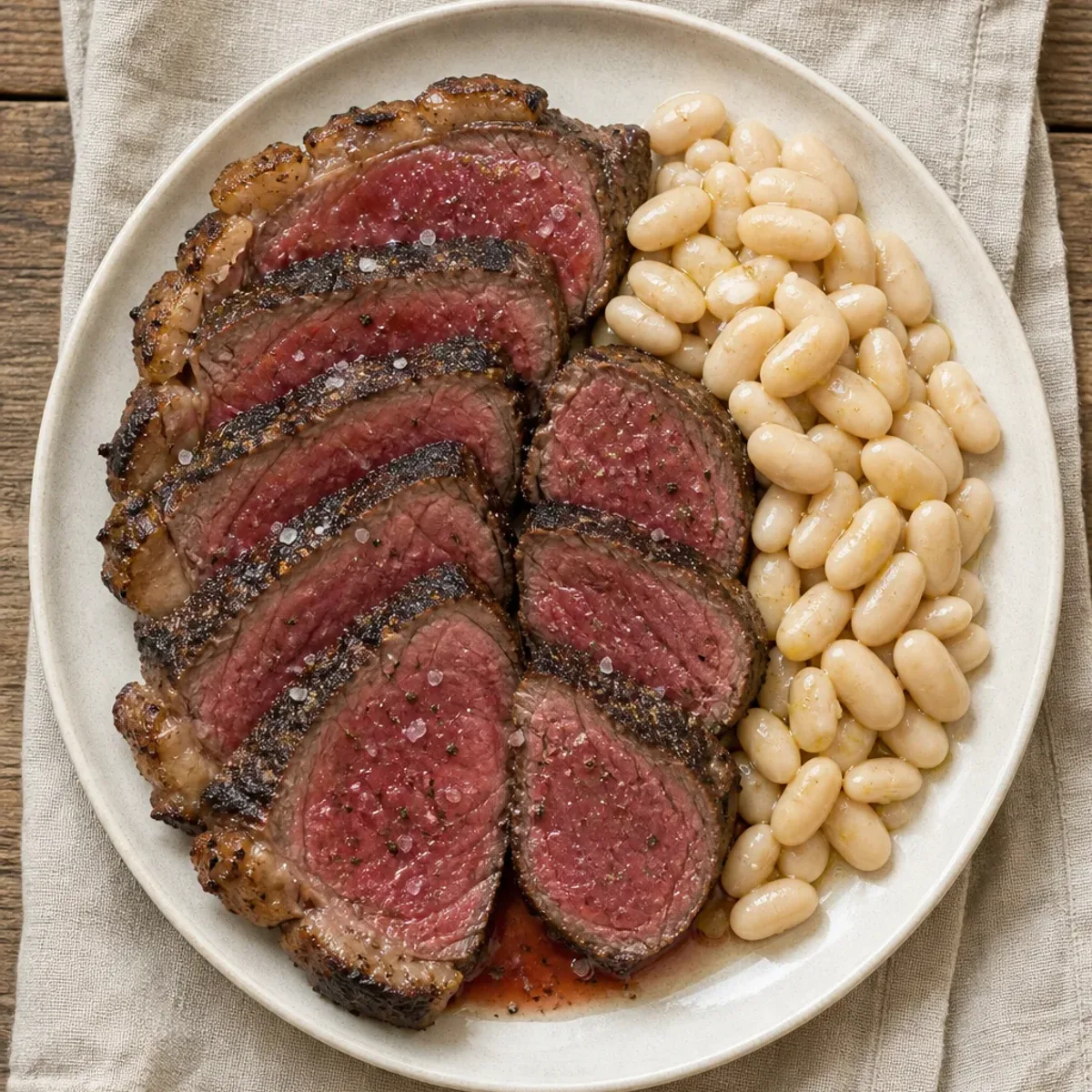
The beans go on the stove while the thick T-bone comes to temperature, and meanwhile a stable bed of ash-covered coals is built up. The meat first develops an undisturbed crust on both sides, then finishes cooking standing on the bone, and rests briefly before it's sliced and shared with the glossy cannellini beans. The key is intense, flame-free grill heat, which builds a crust without pushing the red center too far.
Ingredients
The Steak
- 1.4 kg Beef T-bone steak, about 5 cm thick, ideally from Chianina cattle
- coarse sea salt
- black pepper, freshly ground
- 1 tbsp extra virgin olive oil, for serving
The Beans
- 250 g dried cannellini beans, soaked overnight
- 2 clove garlic, crushed, skin on
- 6 leaf fresh sage
- 3 tbsp extra virgin olive oil
- salt, to taste
How to make it
The Steak
- Take the T-bone steak out of the refrigerator and let it stand covered at room temperature for 1 hour. The meat is ready when it no longer feels cool against the bone — a cold center never has time to heat through before the crust burns. ⏱ 1 h · passive
The Beans
- Drain the soaking water from the cannellini beans and put them in a pot with the crushed garlic cloves and sage leaves. Cover with cold water three fingers above the beans and bring slowly to a boil. Skim off the gray foam as you go, until the surface runs clear. ⏱ 10 min
- Cover with a lid and let the beans simmer very gently for 60-80 minutes, until tender all the way through but still whole and unburst in their skins. Cook them without salt, since salt added early toughens the skins. ⏱ 1 h–1 h 20 min · passiveChef's tip Keep the water barely trembling — visible rolling boil tumbles the beans and splits the skins. If a lid-lifted glance shows bubbles breaking hard, pull the pot half off the burner.
The Steak
- Light the charcoal grill well ahead of time and let the coals burn down for 30-40 minutes. They're ready when the flames are gone and the coals sit under a gray-white layer of ash — you should be able to hold your hand 10 cm above the grate for two seconds, no longer. ⏱ 30 min–40 min · passiveChef's tip Bank the coals in an even, deep bed: the steak needs around 20 minutes over them, and a thin layer loses its heat halfway through. Keep one corner of the grate clear of coals as a free zone.
The Beans
- Drain the cooked beans and fish out the garlic and sage. Toss them hot in a bowl with the 3 tbsp olive oil and salt, until every bean has a glossy coat of oil. Taste and add more salt, since the beans need to taste complete entirely on their own alongside the meat.
The Steak
- Pat the room-temperature steak completely dry and place it on the grate about 10 cm above the coals — no oil or salt on the meat yet. Grill it for 5-6 minutes without moving it, until the underside has a dark, crisp crust that releases from the grate on its own.Chef's tip Surface water must boil off before browning starts, so a damp steak steams and stays gray. When the crust has formed, it lets go of the bars by itself — if it sticks, it isn't ready to turn.
- Turn the steak once with the grilling tongs, and never pierce it with a fork, since every puncture lets the juices escape into the coals. Grill it for 5-6 minutes on the other side, until that side is also darkly seared and the fat edge is bubbling.Chef's tip When the fat edge starts bubbling, fat drips down and the flames leap up. Flames don't sear — they lay down soot and bitterness. Move the steak over to the free zone for the few seconds it takes to die down.
- Stand the steak on its edge with the bone facing down toward the coals and balance it there for 5-7 minutes. The meat closest to the bone needs to heat through while the center stays red — measure 48-50°C in the thickest part.Chef's tip Bone and the thick muscle around it lag behind the rest; standing it upright feeds heat straight into that cold zone. Pull at 48-50°C — carryover adds a couple of degrees during the rest.
- Place the grilled steak on a warm platter and sprinkle both sides with coarse sea salt. Let it rest for 5 minutes, until the juices have settled and the platter no longer collects a pool of juice. ⏱ 5 min · passive
- Cut the two muscles free along the bone in one long cut each, then slice them across the grain into slices about 1.5 cm thick. Arrange the slices back around the bone on the warm platter, cut sides up, showing the red, juicy center. Grind black pepper over the top and drizzle the serving olive oil in a thin stream over the freshly cut surfaces.Chef's tip Find the direction of the fibres before you slice and cut straight across them — slicing with the grain leaves long strands that eat tough, even on a perfectly cooked steak.
- Set the platter in the middle of the table along with the bowl of beans, and let everyone take slices from both sides of the bone. Bistecca is shared from the center and eaten hot, with a spoonful of beans scooped alongside the meat on the plate.